About Me

My photo
Just a meandering soul sharing my backyard. Visit my Flickr page too! www.flickr.com/photos/meanderingwa/

Monday, May 17, 2010

Ancent Lakes

Not really that old.


When I first got into birding I learned a lot about the natural history of the state by going on field trips. Eastern Washington was always a favored destination because it offered a complete change of environment , flora and fauna.


During one of these trips I met someone who was very knowledgeable about geology. He told me about the book "Fire, Floods and Faults" by Marge and Ted Mueller. This clever book is a combination of learning and field trips. The Muellers write about the Bretz Floods and describe road trips where you can see the actual effects of these floods on the landscape.


Recently I completed the book "Bretz's Flood, The Remarkable Story of a Rebel Geologist and the Worlds Greatest Flood" by John Soennichsen. The combination of both these books has allowed me to see and understand how the eastern half of our state was shaped ~12,000 years ago.


Another resource for understanding is the wonderful NOVA story about the Megaflood


www.pbs.org/wgbh/nova/megaflood/


Approximately 12,000 years ago at the end of the last Ice Age a giant ice dam located in the far northwest corner of Montana / Idaho region broke loose and allowed the backed up waters of glacial Lake Missoula to flood out. The waters flowed across Western Washington and scoured the landscape all the way south to the Willamette River valley in Western Oregon. This happened multiple times over a span of ~2000. The exact number is not known. You can see evidence of the multiple water levels and layers of scouring in some of the hills. A type of shoreline effect.


I visited Ancient Lakes in Grant County, about 10 miles north of the I-90 bridge along the east shore of the Columbia River, in Potholes Coulee. It was a magnificent warm day and the sky could not have been more blue.


I had hoped to catch some wildflowers on this hike, which was written up in my guide book. To my disappointment most of the flowers have passed for the year, but I certainly enjoyed getting out.


I arrived very early and feel like I had the place to myself. There was a horse trailer that pulled in behind me, but I never saw the horses and their riders until late in my return loop. I loved being in this ancient feeling place with no other people about.


The coulee is about 4 miles deep and ends with an amazing waterfall. At the terminus of the coulee are three lakes which have no outlets. They are remnants of the massive flood that backed water in from the Columbia to the west and waters that flooded over from the east. The combination of forces dug out deep lakes, like a high pressure hose.


Today waterfalls from the plateau above spill over the basalt rock faces and disappear into the ground. The water does not form streams as you would expect but is soaked up into the ground.


Along the way a nose of coulee floor shows multiple layers which illustrate the shoreline effect. Water once lapped against this nose creating lines of erosion. I would guess this nose is about 300 feet high. The distant wall of the coulee is quite a bit further on.


The trail was pretty level until I got into the shorelines of the lakes. They don't have gentle shoreline on their east faces. The basalt boulders were part of the hike challenge and good training right now for future hikes. Recently I heard or read something about rock climbing. As I worked my way along some of these rocks I heard the quote "Trust your foot"


It helps!


A waterfall at the east end of the largest of the trio of lakes compelled me to scramble up to see what was up there. I did find a new flower to figure out , American Brooklime.


The shores of the lakes had Thelypodium still growing well. The bees loved it and it was fun trying to capture photos.


and had some wonderful views of the landscape. This is from the top of the falls.


Walking back I passed many people hiking in for camping. I am sure this must be a remarkable camping area in good weather. There is absolutely no shelter in bad weather but it must be gloriously dark and wonderful on a clear night.


The cliffs were alive with nesting birds, Cliff and Violet-green Swallows, rare White-throated and Black Swifts and a few Rock Wrens. The wrens are so very hard to see but I did spot one singing from his rock and later, while at the top of the waterfall, saw one come down to drink. I didn't even think to try and get a picture.


I stopped by the Quilomene WR I visited last month with on the Native Plant Field trip to see the Bitterroot in bloom. It was a great pleasure to find many in blood and all over I found buds still breaking through the dry hard soil.


These are surely one of the most beautiful flowers of Spring.

Saturday, May 8, 2010

Larrabee State Park

It has been some time since I have visited Larrabee. Just south of Bellingham along Chuckanut Drive getting there can be a bit of an adventure. The drive from the freeway to the park is along Chuckanut Drive. The first part flat and straight until you reach the base of Chuckanut Mountain. Then it is twist and climb on a two lane road


with no shoulders

and rock faces that jut out from your right

and a drop off to your left.

It make you think reaaaaal skinny thoughts.


Today made more fun with the presence of bikes on a road race / event. Fast bikes and slow bikes. Bikes not staying on their side of the fog line.


But I went to Larrabee knowing that it, like Washington Park, is situated on a scoured off rock face overlooking Strait of Georgia / Juan de Fuca. It is under the slim influence of the rain shadow, just like Washington Park to the southwest. I was hoping to find some unique plant life.


I also have a new pair of hiking shoes to try out. This park presents a nice steady climbing grade that will give them (and me) a good trial. Not as steep with distance as Umtanum, but a good 1000 gain in 1 1/2 mile.


I found, when I arrived, that there was a 50K ultra run going on. Yes 50 Km through the woods over hill and dale, stumbling rocks, roots and some pretty steep hills. It takes them up to 8 hours to run the course. I had a nice chat with a fellow manning one of the resource stations. He was alone and made use of his idle time by moving old bridge planks from a pile in the woods to the back of his pick up truck. Volunteers, you got to love them.


This park is known for its fossil deposits near the beach. I did not visit them, but yet again have another "to do" on my list. Inside the woods you often come upon sudden rock outcrops and cliff faces that show where glaciers of the Ice Age carves out the inland sea and its islands.


Rock like this holds little top soil and usually supports a unique population of plants. Today I found Maidenhair Fern. They like rock and humus, certainly not a common thing in my homeland of central Puget Sound.


I also found Deer Fern fiddleheads. I have never seen them this fresh. They made a pretty picture.


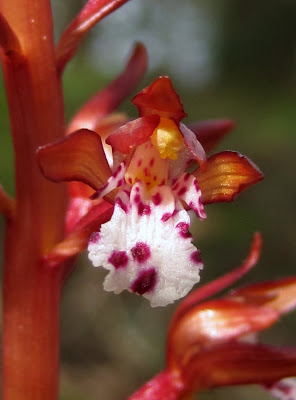
The prize of the day was the Striped Coralroot. These are related to the spotted Coralroot I find at Washington Park. I did find a few Spotted, but today the Striped orchids were the winner.


Today is Migratory Bird Day and I certainly heard plenty of our seasonal visitors. Wilson's and Townsend's warblers, Black Headed Grossbeak, Warbling Verio and Rufous Hummingbird. I had not yet heard Rufus Hummingbird this year, not even at feeders. I saw an item earlier that there is concern that the Washington population has seen a decline for unknown reason. In my common areas, it seems true.


I took a spur trail to the overlook because on a day like this, there is plenty to see.


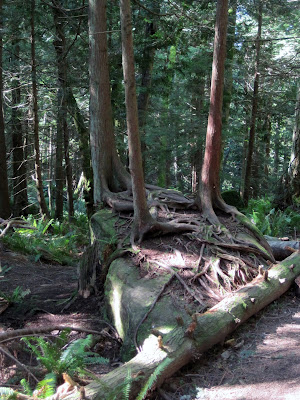
I love this trio of trees growing on an erratic. I inspected closely and there is no longer any soil on the boulder. The roots extend over the rock to the ground and onto the soil. Magnificent.


There are several places where I would feel slightly spooked to be in an earthquake or huge wind storm. Look at how some of these very large trees cling to the edges of the rock face.


Typical western lowland flowers are in bloom. Here Trillium are still holding on. Most of them are just starting to turn their purple hues.


Bleeding heart fill in the edges here and there.


I have never spotted little mushrooms like these. Not sure if they are safe, I suspect not just based on color.


I cannot believe we have another beautiful day ahead.

Wednesday, May 5, 2010

Watch List: Volcanos and Birds


last night I caught, quite by accident, a program on NOVA


"Mt St Helen's: Back from the Dead"


It was was an excellent overview of the last 30 years. It is available for viewing on line.


I am also working through "The Life of Birds" series by David Attenborough via NetFlicks.


It was wonderful the first time I watched it on TV. Seeing it now I so envy the whole production crew on this global journey of bird discovery.


A must for anyone who wants to learn about birds and their habits.


Attenborough body of work is stunning and he has rightfully earned the place as the master of nature documentary.
Suggested viewing for these dreary winter days ;-)

Saturday, May 1, 2010

A May Basket of Delights


Rough winds do shake the darling buds of May...


I didn't hold much promise of a fine day out since leaving work at 10am, all was gloomy and blustery. I decided to go see what was happening in Washington Park. The advantage of rain shadow or convergence zone didn't come to mind. Simply go and take what comes.

Well Hooray for rain shadow and convergence zone. As soon as I got north of the Snohomish county line, the rains let up and upon reaching the park, I was in broken skies and sun.

I walked the now familiar loop road looking for new and interesting things. A Robins egg shows that the first brood of nestlings have hatched.


At Green Point, there were few of the Shooting Stars which had dominated the grass edge in the rocks. Today, a small clump of Chocolate Lily sat unexpectedly on the rocky edge. I later found a wonderful array of them on a mossy bank further inside the island. The are exceptionally difficult to spot with their green dappled tops.


Many of the slopes were well filled with mature forms of Sea Blush and Camas. I spotted small buds of wild onions, most not yet opened.


Many bumblebees taking advantage of all the blooming Sea Blush and I spotted one butterfly. I was getting ready to take a picture when a White-crowned sparrow swooped in and narrowly missed catching it. I tried to get a fun picture of fuzzy bumblebees in the flowers but they were far too lively and fast for my camera.


I stumbled unexpectedly upon a young Red-tailed Hawk in the grass. Clearly it had something . It jumped up with its prize... a writhing snake. It was not until I got home and loaded my pictures up I looked long and hard at the snake. It is green and flat and I don't really know of a snake here that looks like this. The tide was out and the rocky tide pool were just below the slope. I thought it might be an eel, but when asked on Flickr someone I respect as a naturalist answered he felt it was a snake of unknown species.


For a closer look at this photo you can see the original size ( click the magnify icon)
There were many people out enjoying the fine day. These folks were enjoying their private fishing spot.


As usual there were many people walking the loop. I chose the woodland trail through the center of the park and had it all to myself.


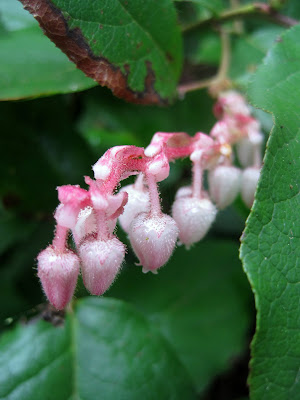
The Salal is in bloom and I encountered some new plants that make we want to return in a week to see how they progress.


I believe this is a Mitrewort, thought I don't know which of two species it is. I asked for some id help on Flickr.


I am not sure what this is but I am hoping it is Pinedrops. I have never seen except in pictures and I will make a mental note to return and double check this trail. There were a couple other mystery growths that gave no clues as to what they are, simply foreign to my eyes.


The Spotted Coralroots were more bountiful.


Nootka Roses had lost a lot of petals to the rain, but these two were prime.


Orange Honeysuckle dangle from a lot of middle story shrubs and trees. Most concerning to me is that I have still to see or hear a Rufous Hummingbird this year. They should have been very busy in the area I found this honeysuckle. There are also a lot of Salmonberry and these two plants should be hummer magnets.


This park remains one of the most remarkable places in this region. I have never seen such diverse plant life anywhere on this side of the Cascades.

Thursday, April 29, 2010

Arbor Day, 2010


WAITING FOR A MESSAGE


Rochelle Mass

Trees help you see slices of sky between branches.


point to things you could never reach.

Trees help you watch the growing happen,


Watch blossoms burst then die,


See shade twist to the pace of the sun,


Birds tear at unwilling seeds.


Trees take the eye to where it is,

to where it was,

then over to distant hills,


Faraway to other places and times,

long ago.


A tree is a lens,

a viewfinder, a window .

I wait below


for a message

of what is yet to come.

Wednesday, April 28, 2010

Another Experience to Tick Off

Monday I spent the day with three other members of the Native Plant Society. We left Issaquah at 8am and traveled to the Vantage area. The planned activity was to study the plants of the Sage steppe.


I am a rank beginner when it comes to this level of "botanizing" Plants are discussed but common names are not used. The taxonomy names are used. To my ear they sound incomprehensible, even though I know and use words like them daily. Having learned "buckwheat" "desert parsley" " Milk-vetch" it was difficult to be nimble with Eriogonium , Lomatium and Astragalus. Those are just the Genus names, each one has several species attached and in some places distinct sub-species.


But everyone one was nice and we each had our own area of interest. The leader of this trip was more welcoming and supportive than the previous trip I experienced. I think the smaller group was a huge plus.


The weather was perfect, overcast with almost no wind. The Columbia River and the areas surrounding it, particularly west towards the Cascades, are known for their persistent winds. Wind farms are springing up. This is the Wild Horse Project. One of the trip members told me that they have a nice visitors center. I asked her if they allowed people to ramble the property and visit the environment. She was not able to really answer that so I might have to pay a visit and find out for myself. I can imagine that they would not like people near their equipment but it does look like a way to get into this difficult area.


Our first stop was at the Quilomene Wildlife Refuge. I have never explored this area beyond the small patch we visited this day. The roads are usable only with a solid , high clearance 4WD vehicle. We climbed slope of this south facing canyon and slowly explored the plants along the way.


For me it is about appreciating the change of plants and their community in this small environment. The average plant community is dominated by rabbit brush , bitter brush and other sage plants. Hard woody and somewhat dangerous in a thorny way. Smaller plants and flowers often grow tucked inside, using shade and conserving evaporation.


When we reached a steeper bit of slope, the soil gave way to more rocky ground. The plants changed and it was here that the Snowball Cactus were everywhere. Many of them were in flower. Our leaders commented here that the flowers were more open on their previous visit, a windy sunny day. It was early and overcast so the full bloom was lacking, What I saw, however was perfectly wonderful.


At the very top of the hill we had a further change in the soil and there were more grasses and delicate greenery. Violets and Spring beauty could be found. We found a large slope of Large-headed clover. These were by far the largest blooms of this plant I have ever seen and certainly the largest numbers of them.


Three hours on this slope passed far too quickly. We drove to the end of the road at the Ginko SP Headquarters. I have not been here in some time and was thrilled to see that the facility has all new signs and everything has been cleaned up. This site is a great place to take a rest break on a long cross-state journey. You have a great look at the stunning walls above the Columbia River and learn a bit about the floods that formed the area.
The nearby Petrified Forest is another good place for a ramble. It is a large open slope and in the summer there is no shelter from the persistent sun, so arrive early. There were many very large petrified logs though none with identifying signs. I was struck by the beautiful blue streaks in this one.


We went south along the river to the foot of Sentinel Gap and explored the first of two sandy soil sites. There was an abundance of Larkspur and Brodiaea (the blue type) blooming here. There are several types of Asters as well as an abundance of Lupin. These are low growing and more unassuming than you see in the wet meadows around Mt Rainier. All perfectly understandable given the hard living conditions. High wind, low moisture a lot of sunlight and heat.


We crossed over the river and I knew that the potential highlight of the day was next. Sand and dune ecology is found here in the along the east side of the Columbia. The area I visited near Hanford, White Cliffs is a good example. I knew some of the valleys leading away from the river held dunes. All of these canyons and valleys were part of the great Bretz floods which formed the landscape of the majority of the eastern basin ~10000 years ago.


I did not expect that the stop would come so soon. We pulled over on the side of the road in a place I had passed many times. I always thought of this as a spot where truckers could have a safe place to pull off the road. I never realized that there was a "day use only" spot leading down slope nearer the river. We scrabbled through a barbed wire fence and had yet another different environment, sand on bare basalt rock.


There were many of the foundation plants but also some new delights. Here wild onion suffered to grow only three inches high. By the time they put out a bloom, their leaves were usually gone.


Narrow-leafed Phacelia grew in many places as a single stem and blossom, here I found several that produced wonderful bouquets.


The highlight of the trip, a Sand Dune Penstemon already starting to fade. The leader was at this site only five days previous and noted the flowers that were failing. A stunning bit of beauty in an area many might feel has nothing to offer.


I could have stayed out longer and kept rolling on but it was already 5:00 and we faced 2 1/2 hours drive home. It was nice to be able to watch the landscape go by, the luxury of someone else driving. I had a great talk with another member of the group and it felt like in no time we were back at REI in Issaquah. I grabbed the opportunity to go in, wearing my hiking shoes and my feet and their end of day condition to buy a new pair of hiking shoes.


I now own a pair of size 10 1/2 hiking shoes. Somehow that "1/2" makes me feel like I have REALLY big feet, not just big feet. That darned second toe on the left foot is the one to blame.


So home to post one quick photo for my 365 project. There was no way I could bring myself to puzzle over the photos and plant ID's nor to write a scintillating blog entry.


While working on my Flickr entry I felt something on my arm and there it was... A tick walking up my arm.

My first TICK. All these years of tromping about in the eastern Washington area I had never encountered a tick. Now, 48 hours later, my skin has almost stopped crawling and every wisp of hair or stray thread is not a voracious arachnid threatening to lock into a vein.