About Me

My photo
Just a meandering soul sharing my backyard. Visit my Flickr page too! www.flickr.com/photos/meanderingwa/
Showing posts with label Madre de Dios. Show all posts

Saturday, June 25, 2011

Like Here, Only Different ~ Bird Observations

One of the main attractions of Peru, indeed the equatorial / near tropic regions is the abundance and diversity of bird life.  Peru has over 1800 recorded bird species.  North America has 914.

I found the bird spotting exceptionally difficult and photography even more so. The dense jungle, you have experienced.  No sooner would you get a near sighting of a bird then it flitted off.  Many of the birds are camouflaged either leaf colored or brownish.  Trying to see up into poor lighting results in a drab silhouette which defies classifications. My zoom camera chewed up batteries and solar recharging meant that it was limited in its use.  It was not possible to have it trigger ready in an instant.  Often when I was out, particularly early in the morning, I was working in teams and there was little time to stop and muddle over a bird flicking about in the top of a tree.

But there was still great birding.  The major draw for this region are the clay licks, known as colpas.  I had learned that colpas were important to the birds and animals of this region as the kaolin in the soil detoxified the alkaloids in the foods they eat.  This idea was part of a published study which has since been proven wrong.  The soil contains sodium and potassium which many of the plants lack.  It is mineral seeking not detoxification.

Part of our daily routine was for two teams to make observations at the Macaw colpa of Red and Green Macaw.  The early shift was 6am to about 10am, the late shift 10 to 2.  Jose transported two of us across the river and we made a short hike to the blind.  Every five minutes observations were made on the Macaw behaviors.  We counted each bird we could see and characterized their behavior and position; high in trees, low in the tree-line (shrubbery) or on the lick.  Behaviors included preening (self or others)  watchful, flying, fighting, playing, eating, walking and sleeping.


There was not a lot of action for the early shift.  Early birds were usually the small parrots and parakeets.  I particularly liked the bold colors of the Blue-headed Parrot.  They were easy to learn and identify.  It was a pleasure to be able to watch them without gathering data. 


While I never saw them at the colpa, I did have one stunning viewing of Blue and Gold Macaw.


Scarlet Macaws were also in the area, but less frequent at the colpas.  Many of the small parrots popular in the cage bird trade are found here. 


As the morning moves on the Macaws arrive and displace many of the little parrots.  Most of their time is spent on sitting high in the environment preening and watching.  They very slowly make their way lower in the trees and, as if by some signal, enter the colpa as a large group.


We kept track of the presence and passing of boats, even noting the type of motor they have, conventional outboard or noisy Peque Peque. 


Scientists are working to determine the disturbance of the animals in the environment and the boat traffic is one concern.  This is especially true when it comes to eco-tourists and increasing industry of this area of low development.  Birds coming overhead would also make the parrots flee.  I was surprised to see their reaction to Vultures and have to wonder if this is simply a flee now ask questions later behavior.  They returned quickly.


Future work will also look at the bird behavior and to see if the birds make use of a sentinel bird as part of their flock safety.  Many mixed flocks here at home will have certain species that are alarm triggers. It will be interesting to see if anything is found out about other species serving as a sentinel as well as same species behavior.

I would have liked to have had more opportunity to go to the Macaw colpa, but there were many duties and rotations to go on and sadly I only visited once.  Parrots were all around, however and they were easy to spot due to their noisy flocks.

In the jungle there were several key birds we kept track of and I was lucky to see many Spix Guan. 


The classic "heart attack bird" is the White Winged Trumpeter.  They would hold quite still until you got very close then they would fly away with a burst of startling sound.


I also had one spotting of a Razor-billed Curassow.  These large birds are potential prey for the carnivores of the jungle.  They also eat clay.


Birds for birding sake were many and varied.  Toucans and Woodpeckers were always fun to spot.  I was pleased to see and identify some of the drab antbirds and woodcreepers.  At night I could hear owls calling.  The Smooth-billed Anis were always skulking around the yard


and on our way home, Jose stopped near shore to allow us a look at the prehistoric looking Hoatzin.


 I even spotted a Bluish-fronted Jacamar on an afternoon walk.  This is certainly one of the birds I wished to meet.
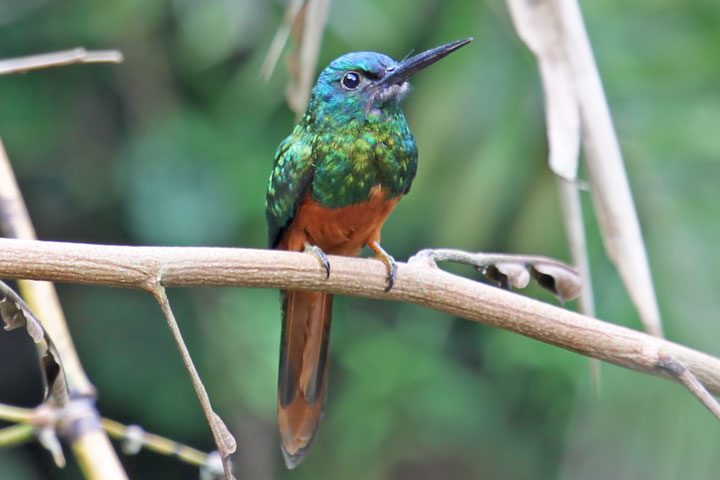


The capper of all bird sightings came on my last walk in the jungle, the morning we left.  Rita, one of our group members, pointed the bird out to me and I was thrilled to see it.  Alan said it was the prize for beauty and I agree.
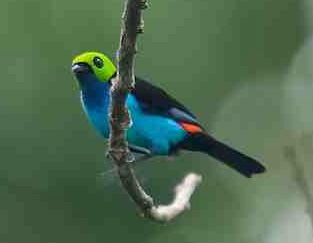


Paradise Tanager.  Thank you Dr Rita for your Eagle Eyes!


For me,however, for all the flash and color and amazing qualities, nothing beats my little Paraque.  He was my special little bird, the one I saw and never really saw.  Paraque are birds of the nightjar (nighthawk) clan.  I entered my room one night and my head lamp kicked back a reflective spot across the yard.  One bright dot... NOW TWO.  Now one , then two.  I put my binoculars on it and sure enough I could see a pair of eyes looking back at me.  Only two things produce that head swivel, one-eye two-eye effect,  owl or nightjar.

I discussed with Alan and he said it would be Paraque.  Mr Paraque was there, night after night at the same spot.

I tried many times to get a picture and I can barely believe my luck that I was able to capture something on film.

see the little white dots?


Means the world to me.

I would love to take credit for these photographs but must say most of the bird photos are from Google images.  The Ani, Vultures and the Parque are mine.

More than seeing bird is hearing them, night and day.  The jungle sounds just as it does in every movie and documentary you see.   Rarely do you see the birds that make the sounds but their noise is ever present.  The Screeming Pihas started at about 10am every day.  They are THE sound of the Amazon lowlands.  For such a noisy bird, they are unremarkable, drab, hard to spot.


I was out on a transect walk with Alan when I head this song.  The Musician Wren.  I got a fleeting glimpse of brown but the song was nothing like the pretty singers here.  The clarity , the projection, the ring.


Stunning.

For anyone with a passion for birds I can only recommend David Attenboroughs wonderful "Life of Birds" documentary series.  It is on Netflix as instant watch.


I am so thrilled that I was able to experience even a little slice of bird heaven.


Like Here, Only Different ~ For Cornelius

WARNING ALL SORTS OF BUGS!!!


Thursday, June 23, 2011

Like Here, Only Different ~ Into the Woods

My familiarity with my home woodlands makes me feel comfortable in any situation I face when out and about locally.  When I enter a different environment, however, my usual tools are a bit weak.  I don't know the names of plants and trees and do not recognize stand-out plants.  Typically I make use of contour and terrain to orient to the direction (compass) and recognize a location I have passed before.
But here in the jungle all bets were off. 


The land is almost perfectly flat.  There were some small hills and gullies, usually associated with a stream or the area near the river where small streams have cut deep.  One factor is that it is hard to see where the sun is coming from.  Blue sky was rare in the dense jungle and even when you could see it, the direction the sun was shining from was hard to tell. 


In addition, right now the sun is in the north, totally opposite to my usual "sun to the south" orientation.

Flying out of the Andes to the eastern country it was miles and miles of treetop with no obvious hills.  Here at home, handy mountains and bodies of water can keep you pointed in the right direction.  In our little exploration territory, the saving grace was that there are very little in the way of paths.  Only those hacked out and trod upon were available.  The Las Piedras river was our boundary and North was always the direction for home.  A large stream and waterfall behind the main compound was a catching feature.


On the reserve, four major trails or "Transects" occupied our time.  It was along these trails; Mammal Colpa , Brazil Nut and Transects A and C that we did our walking observations.  There was a minor trail called the Waterfall which had a small amount of new work started.  Typically it was a trail for a pleasure stroll.

But this jungle certainly held familiar sights.  Fungus of all types serve to break down rotting wood and convert it to usable nutrients.  Sometimes it was questionable as to what an item was spore or fungus.


Many of the leaves that have fallen appeared similar in type and structure to some at home.  It is now the dry season and the leaves in places were quite thick.  Breathing deep I appreciated that they smell like the November woods here at home, only not at 85 degrees.  I even had a shoofle through some.


Occasionally a small marshy are would appear and I had a good look at a Tiger Heron in one.  During the wet season the iconic and colorful tree frogs come down from high in their trees to find mates.  It is here in the marshes you will see them.  After mating they return up the trees and lay their eggs high in bromeliads and holes. 


Every layer of the forest is filled with plants and trees and there is seldom an open area.  Occasionally , where tall trees dominate you can see into the low understory, but usually it is clearly an area that will swallow you up within 5 meters.  Observations of animals is primarily with the ears rather than the eyes.  Birds are exceptionally elusive.

Like here at home, crossing ditches and wet areas can often be a matter of a few logs plopped across the waterfeature.  My favorite bridge had a nice hand rail that was lashed into place with vines.  A sturdy 2 x 8 plank was a luxury.


Trees are massive and high.  Ironwood, an iconic tree of these jungles can live for over 1000 years.  These are the trees prefered by Macaws for nesting.  They are harvested for their timbers. Since they take such a long time to grow to the appropriate size for nesting, the loss of these trees can be quite devistation to the total environment.  Thankfully Macaws accept nesting boxes and efforts have been made to establish them in area impacted by illegal logging.

This cedar type tree was poached from right near our Macaw Colpa.  We saw Mahogany rafts made of sawn timbers at our canoe port when we returned home to Puerto Maldonado.  Mahogany poaching is a big problem and it is a wood best not considered for new construction.  Salvaged Mahogany can be found in old buildings but export of prime new wood continues.


Brazil Nut Trees give out their fruits in the shape of a cocoanut like ball.  If you shake them you can hear the nutlets rattling inside.  Brazil Nut farming is a sustainable crop.  The large nuts are collected in baskets then machette opened to release the individual nuts, whch are raked and dried in the sun.  We found many rotten nuts which are left behind.  Some of our group had the fun opportuntiy to watch a monkey trying to break open a nut casing.  They had a laugh when the poor animal dropped the difficult fruit after failing to whack and bite it open.  They said it truly looked disappointed.


Vines are everywhere.  Many of them we recognize from the indoor plants in our home.  Ficus and Philodendron grow in many colors and forms.


Strangler Fig can grow to massive dimention, completely ovewhelming the tree upon which it grows.


One Fig called a Walking Fig can actually move as much as 5 meters in its lifetime.  The stiltlike legs can adjust the position of growth for optimal light conditions.


Like here at home, trees support a wide array of ferns and symbiotic plants such as bromeliades  High up in the branches of the highest tree is where orchids take root.  I carefully looked at the fallen trees to see if I could find blooming orchids and I did find one.  Many of the orchids were not in bloom , much to my disappointment.  During one work session, Sara, one of the scientists, collected small orchid plants from a fallen and crushed log.  She tries to salvage and propegate them at home.  Some of the trees around camp support rehomed orchids.  I placed plants that had fallen from trees back onto logs and into tree crotches in hope that they would take root in the bark.


It did not take me long to feel comfortable in this environment.  I began to recognize certain trees and became aware of distance marker ribbons.  I often knew how far to Base Camp.

When it is 90 degrees and you have been out walking for six hours with your water running low, this is vital information to have.  I did have one misadventure involving direction, fatigue and route finding.

More about that later.