About Me

My photo
Just a meandering soul sharing my backyard. Visit my Flickr page too! www.flickr.com/photos/meanderingwa/

Tuesday, June 28, 2011

Like Here, Only Different ~ Slow Walking

A larger part of our day to day work activity involved walking.  Very. Slow. Walking.  I think, aside from the need for a lot of insecticide spray/repellent, I found walking slowly VERY challenging.

Transect walks and behavior observations were done daily on any of the four  transect trails; Mammal Colpa , A, C and Brazil Nut.  Each was a different length but most range from 3 to 4 Km one way.  I loved having a good, solid walk every day in such an interesting environment.  The Brazil Nut trail was the longest at about 10-12 Km round trip.

During Transect walks, a team of two or three observers, led by one of the scientists, walked the length of the trail.  The goal was to find key animal and bird species in the environment and when they were encountered collect data on their numbers, behavior and location.  Questions about the impact of humans in the populations and behaviors of the animals require more data as eco-tourism increases.  The needs of key or threatened species like the cats must be established.  Range, territory and prey species need to be understood.  How the mineral colpas serve the needs of the animals may lead to considering their locations and abundance in protecting habitat.

Typically the scientist would lead, focusing on the immediate area on, above and next to the path.  The second would watch the area slightly deeper into the habitat and above.  The person in the rear observed even deeper into the habitat and to the rear to make sure there was no animal following or fleeing behind.

We walked at 1 Km /hour which is a very slow pace for me.  It was also important to maintain as quiet a step as possible.  Sometimes this was a challenge given the amount of leaves on the ground and the presence of twigs and stems.  Silence was also important as often the only hint of an animals presence or fleeing was the rustle of the vegetation.  This ditch crossing and trail are somewhat typical of many of the paths.  Rustly leaves.  Trying hard to be quiet is a challenge.  Like trying to sneak into the cookie jar, the harder you try, the more you fumble.


When an animal was encountered they were watched and their behavior or reactions were categorized.  We also recorded their distance from the trail and height above the trail using range finders.  Where there were multiple animal, there was an attempt to count the number of juveniles and babies.  Usually the animals flee and are not seen by all the team members.  The best chance of seeing animals was during the primate encounters.  Typically the monkey troops were spread over a wider area and they passed overhead in noisy , tree crashing flights. 

Saddleback Tamarins were particularly fun to encounter.  These small monkeys have sort of a feisty attitude, in my opinion.  At times one would approach as if it was far to fierce to be reckoned with and we better leave, by golly!  Mostly a lead animal would watch steadily as the rest of the troop would move away.  Their departure was typically a somewhat purposeful but not frantic navigation.  It seems they were the ones most likely to come near, or be in the lower middle story.  I only got one fair photo of monkeys during the trip.  Usually they were simply too high and better observed in binoculars.


Small mammals of the jungle are challenging as they have the dense understory to shelter them from our eyes.  Paca


and Agouti were most common


with Brocket Deer also possible.


One species we always knew when they were about.  Even if they were not there, we knew they had been.  White-lipped Peccary live in herds of 50+ animals.  They are noisy with squeals, rumbles, clicks and rooting sounds much like common swine.  Their most notable characteristic is their smell.  Holy Cats you know when they have been in your environment!  The smell seems too linger in the nostrils like all musky scents.  They are also potentially dangerous if they charge as they are not afraid of charging right past or through your group.  When they run they really cover ground.  I did get to have one observation of a group of about 75 animals ranging for tiny babies to large adults.  I felt I could still smell them a few hours later.  These animals are the Jaguars main prey species.


White-wing Trumpeters earn the name of Heart Attack birds as they would sit right at trails edge until you came close they they would blast away in flight.  I had more than one "heart attack" during my walks.  Spix Guan I nicknamed the Jackass Birds as their braying alarm call reminded me of a Mule.  I think, aside from the tamarin troops these were the most common target species encountered.  I usually got a good look as they would fly up and perch on a branch before moving off.

It was a great treat to get a couple encounters with Tamandua.  These pretty anteaters spend most of their time int he trees seeking ants and termites.  Termite nests are easily spotted in the trees but the Tamaduas, with their slow moving way, were quiet and less obvious.


Creatures that eat ants and termites have a good living in this environment.  Ants of all types are everywhere and termite nests seem just as plentiful.


Our walks usually started around 545am and we walked (slowly) out about 3.5 to 4 Km before turning around and coming back to camp.  At the study pace this was usually 6 hours.  During the second week we covered some of the transect trails in reverse, walking all the way to the far end then starting back (slowly) at 6am.  This meant getting up at 330 to hit the trail by 4am.

This day we had a shortfall of provisions due to a logistics issues and packed some cookies and crackers to nibble on before starting our walk at 6am.  I have to say there was something sort of special sitting on a log deep in the jungle as it woke up, eating Oreos.

The great bonus of doing this transect is that we were 1 Km from home base when we finished.  A short quick walk and there we were.  It was 11 am and why not, we peeked into the kitchen.  We struck it rich with our special treat.


It was so good and so welcome I took a picture of it.

Chef Rosie's Buñuelos and Coffee.  The Coffee was that which was picked on the neighbors farm property and roasted right there.  The buñuelos are made with pumpkin puree, flour, eggs and milk then deep fried.  Strawberry jam and Dulce de Leche are the topping.


Sweet tasty bites of heaven. 

As before, the animal photos, except the tamarin, brought to you by Google Images.  (sigh)

Saturday, June 25, 2011

Like Here, Only Different ~ Bird Observations

One of the main attractions of Peru, indeed the equatorial / near tropic regions is the abundance and diversity of bird life.  Peru has over 1800 recorded bird species.  North America has 914.

I found the bird spotting exceptionally difficult and photography even more so. The dense jungle, you have experienced.  No sooner would you get a near sighting of a bird then it flitted off.  Many of the birds are camouflaged either leaf colored or brownish.  Trying to see up into poor lighting results in a drab silhouette which defies classifications. My zoom camera chewed up batteries and solar recharging meant that it was limited in its use.  It was not possible to have it trigger ready in an instant.  Often when I was out, particularly early in the morning, I was working in teams and there was little time to stop and muddle over a bird flicking about in the top of a tree.

But there was still great birding.  The major draw for this region are the clay licks, known as colpas.  I had learned that colpas were important to the birds and animals of this region as the kaolin in the soil detoxified the alkaloids in the foods they eat.  This idea was part of a published study which has since been proven wrong.  The soil contains sodium and potassium which many of the plants lack.  It is mineral seeking not detoxification.

Part of our daily routine was for two teams to make observations at the Macaw colpa of Red and Green Macaw.  The early shift was 6am to about 10am, the late shift 10 to 2.  Jose transported two of us across the river and we made a short hike to the blind.  Every five minutes observations were made on the Macaw behaviors.  We counted each bird we could see and characterized their behavior and position; high in trees, low in the tree-line (shrubbery) or on the lick.  Behaviors included preening (self or others)  watchful, flying, fighting, playing, eating, walking and sleeping.


There was not a lot of action for the early shift.  Early birds were usually the small parrots and parakeets.  I particularly liked the bold colors of the Blue-headed Parrot.  They were easy to learn and identify.  It was a pleasure to be able to watch them without gathering data. 


While I never saw them at the colpa, I did have one stunning viewing of Blue and Gold Macaw.


Scarlet Macaws were also in the area, but less frequent at the colpas.  Many of the small parrots popular in the cage bird trade are found here. 


As the morning moves on the Macaws arrive and displace many of the little parrots.  Most of their time is spent on sitting high in the environment preening and watching.  They very slowly make their way lower in the trees and, as if by some signal, enter the colpa as a large group.


We kept track of the presence and passing of boats, even noting the type of motor they have, conventional outboard or noisy Peque Peque. 


Scientists are working to determine the disturbance of the animals in the environment and the boat traffic is one concern.  This is especially true when it comes to eco-tourists and increasing industry of this area of low development.  Birds coming overhead would also make the parrots flee.  I was surprised to see their reaction to Vultures and have to wonder if this is simply a flee now ask questions later behavior.  They returned quickly.


Future work will also look at the bird behavior and to see if the birds make use of a sentinel bird as part of their flock safety.  Many mixed flocks here at home will have certain species that are alarm triggers. It will be interesting to see if anything is found out about other species serving as a sentinel as well as same species behavior.

I would have liked to have had more opportunity to go to the Macaw colpa, but there were many duties and rotations to go on and sadly I only visited once.  Parrots were all around, however and they were easy to spot due to their noisy flocks.

In the jungle there were several key birds we kept track of and I was lucky to see many Spix Guan. 


The classic "heart attack bird" is the White Winged Trumpeter.  They would hold quite still until you got very close then they would fly away with a burst of startling sound.


I also had one spotting of a Razor-billed Curassow.  These large birds are potential prey for the carnivores of the jungle.  They also eat clay.


Birds for birding sake were many and varied.  Toucans and Woodpeckers were always fun to spot.  I was pleased to see and identify some of the drab antbirds and woodcreepers.  At night I could hear owls calling.  The Smooth-billed Anis were always skulking around the yard


and on our way home, Jose stopped near shore to allow us a look at the prehistoric looking Hoatzin.


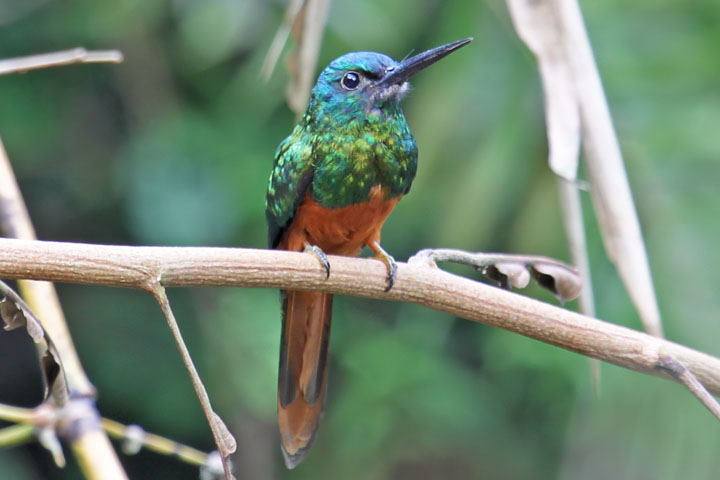
 I even spotted a Bluish-fronted Jacamar on an afternoon walk.  This is certainly one of the birds I wished to meet.


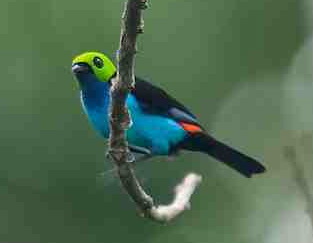
The capper of all bird sightings came on my last walk in the jungle, the morning we left.  Rita, one of our group members, pointed the bird out to me and I was thrilled to see it.  Alan said it was the prize for beauty and I agree.


Paradise Tanager.  Thank you Dr Rita for your Eagle Eyes!


For me,however, for all the flash and color and amazing qualities, nothing beats my little Paraque.  He was my special little bird, the one I saw and never really saw.  Paraque are birds of the nightjar (nighthawk) clan.  I entered my room one night and my head lamp kicked back a reflective spot across the yard.  One bright dot... NOW TWO.  Now one , then two.  I put my binoculars on it and sure enough I could see a pair of eyes looking back at me.  Only two things produce that head swivel, one-eye two-eye effect,  owl or nightjar.

I discussed with Alan and he said it would be Paraque.  Mr Paraque was there, night after night at the same spot.

I tried many times to get a picture and I can barely believe my luck that I was able to capture something on film.

see the little white dots?


Means the world to me.

I would love to take credit for these photographs but must say most of the bird photos are from Google images.  The Ani, Vultures and the Parque are mine.

More than seeing bird is hearing them, night and day.  The jungle sounds just as it does in every movie and documentary you see.   Rarely do you see the birds that make the sounds but their noise is ever present.  The Screeming Pihas started at about 10am every day.  They are THE sound of the Amazon lowlands.  For such a noisy bird, they are unremarkable, drab, hard to spot.


I was out on a transect walk with Alan when I head this song.  The Musician Wren.  I got a fleeting glimpse of brown but the song was nothing like the pretty singers here.  The clarity , the projection, the ring.


Stunning.

For anyone with a passion for birds I can only recommend David Attenboroughs wonderful "Life of Birds" documentary series.  It is on Netflix as instant watch.


I am so thrilled that I was able to experience even a little slice of bird heaven.


Like Here, Only Different ~ For Cornelius

WARNING ALL SORTS OF BUGS!!!