About Me

My photo
Just a meandering soul sharing my backyard. Visit my Flickr page too! www.flickr.com/photos/meanderingwa/

Monday, February 27, 2012

Z ~ Zonotrichia leucophyrus , White-crowned sparrow


This is, without a doubt, one of my favorite bird photos. 

The White-crowned sparrow is a harbinger of Spring.  The males perch up on shrubs trees and just about anyplace and sing their sweet song...

"I'm a Pretty little bird(ie).

In different regions of North America this birds song will vary.  Sometimes buzzy or rusty sounding, other times clipping off syllables of the phrase.  I think the "I'm a pretty little birdie" is unique to the Puget Sound and Vancouver BC area.

To me it is a sure sign of Spring.  The males should be showing up in the next three weeks or so.

I think they come on the same bus as the Rufous Hummingbirds.


Sunday, February 26, 2012

Y ~ Yew , Taxus brevifolia


The Western Yew, Taxus brevifolia, is a scarce tree in our local ecology.  When timber harvesting was widespread, the yew was seen as a junk shrub/ tree and simply of little value and in the way.  The Yew were pulled down to allow easier access to the preferred timber trees.

Native peoples made very wide use of the shrubs.  The wood was very hard and durable and was perfect for carving.  It would smooth and polish up well and could be made into any useful item imagined, even fire tongs.  The berries were eaten in small quantity and the needles were used for smoking.

In recent years the investigation of the alkaloids in Taxus species led to the discovery of the anti-cancer drug Taxol.  The Taxus species of Europe contain higher concentrations of the alkaloid taxine.  There was a bit of excitement during the time after discovery and before large scale chemical ( artificial) synthesis. Some people planted Pacific Yew as a potential crop for the pharmaceutical industry.  Pacific Yew contains low levels of taxine, so I am not sure there would have been much of a return for investment.  It is still possible to find web pages encouraging the plantation of Yew and the potential for good income.

Saturday, February 25, 2012

X ~ Xerophyllum tenax, Bear Grass


The dreaded "X" !!!

Bear Grass is a fun, showy plant and some people look forward to its blooming every year.  They can be quite dominant and abundant on sunny slopes and meadows all the way up to the tree line.  The flower clusters are quite scented and attract bugs galore.  It is always a good bet for some kind of bug photography.

Bears do like the early , fresh leaves of this plant.  The leaves look much like tough wiry grass but the early shoots are quite juicy and fleshy.

The flowers stalks and leaves dry during their die-back.  Native peoples used the tough leaves as materials for making hats , capes and baskets.

The name Xero (dry) phyllum (grass) tenax ( tough) tells you this.

The above Bear Grass blossom was photographed at Sun Top and the bug is a syrphidae fly.

The picture below was taken in July, on the upper meadow of Bandera Mountain, above I-90 just west of the summit. 

Friday, February 24, 2012

W ~ White Bluffs, Hanford


It is odd to think of such a place of beauty at the backdoor of the Hanford Nuclear Reservation.  But it is the reservation which actually as the foundation of this lands beauty. 

The Hanford Reach National Monument was created as a buffer zone around the Hanford Reservation.  Along with the adjacent Yakima Military Range and the Hanford Reservation itself, it preserves a large swath of steppe, grassland and dessert.  From space the vegetation borders of these areas can easily be seen.  Recent news that the Arid Land Ecology unit west of Hanford was once again going to be open to hikers excites me very much.  I visited once with an Ornithology convention and the wonders we saw on our short visit made me want to return.

The area is given to very harsh extremes of weather and ecology.  Stunningly dry its large treeless areas can be a challenge in sunny weather.  Wind can be fierce and also draws moisture from you.  I never venture out into this area without 2 gallons of drinking water in the car.

The Columbia river cuts through the middle and it is here the river flows freely, unencumbered by the multitude of dams and their effects.  On the east side of the river thick chalk hills are cut and show their gleaming white face.

It is easy to ramble for hours along this cliff face.  In the Spring the ground is alive with flowers and bugs of all descriptions.  Bird congregate around rivers, streams and the pothole ponds and lakes that stud the area.  Much of the region to the north and east of here was carved by the Bretz Floods.  These floods left numerous ponds and lakes behind.  White Pelican and Sandhill Crane can be found along these waterways. 

http://www.fws.gov/hanfordreach/index.html

Thursday, February 23, 2012

V ~ Volcano


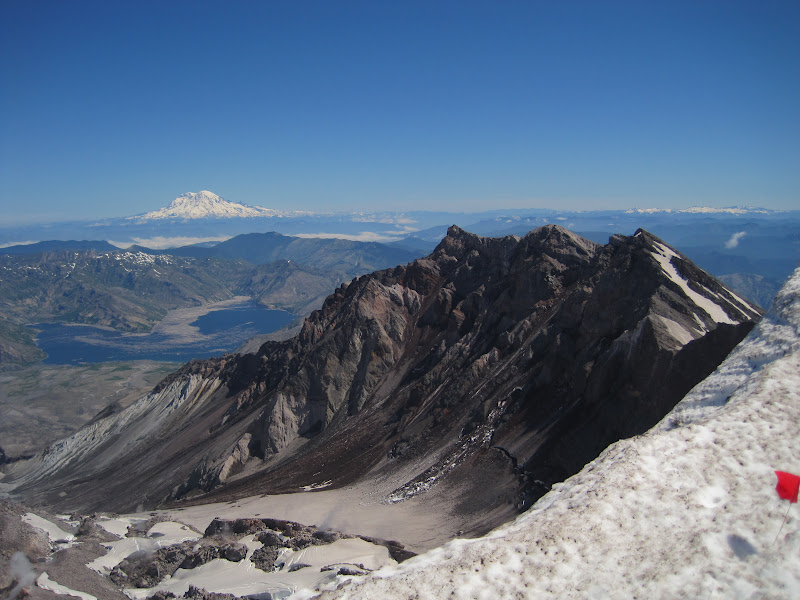
Without a doubt, the volcanoes of Washington State are a surprising lot.  Most people can look at Mts Baker , Rainier, Adams and St Helens and know just by appearance that they are volcanoes.  More surprising is Glacier Peak, a rough craggy mountain in the central Cascades.  This mountain does not have the classic cone shape that defines our other regional volcano's.

All have potential to erupt in the future.  Their eruptions are not set in any fixed rate of frequency, like some volcanoes of the world.  All produce lahars, flows of ice mud and gasses.  These mud flows are responsible for many of the flat fertile areas of western Washington.  The Osceola Mud flow of about 5000 years ago is said to have originated at the top of Mt Rainier, lowering it by 2000 feet and producing a mud reaching to Puget Sound.  It is said that it created up to 450 sq Km of new shoreline and in some places still measures 200 feet deep

There has been a lot learned from Mt St Helens both during its eruption and the subsequent growth phase.  Science of eruption improvement has advanced and data collected on St Helens has aided in predicting dangerous events in other areas of the world, no doubt saving many lives.

The above picture taken from Mt St Helens in July 2010.  Mt Rainier is seen in the distance, about 50 miles north.

Wednesday, February 22, 2012

U ~ Um(p)tanum


Umptanum or Umtanum are both the same word.  Like many Native language words, the phonetic spellings of these non-written languages give rise to a lot of variation.

But the meaning is always clear, the word means Contentment.

It is said the ridges of this upland area was home to many native animals such as Pronghorn Antelope, Elk and Deer, Jack Rabbit and some Mountain Goat.  The canyons running to to the river basins were often mild and snow free.  It was here that native peoples could count on finding food species in harsh seasons and access to their grassy grazing areas in the Spring and Summer.

I spent many hours along the top of the plateau doing bluebird nest box census.  I also gathered nests for an Entomologist to study nest parasites.

Time and again I was drawn to this spot.  I had thought, through faulty reading, that this was an old stagecoach stop, but I have since learned that this was an old wheat ranch.  I met an elderly gentleman here who said he lived on this place during WWII.  To the east of this ridge the Yakima River has dug a great canyon and the hiking in and out of the canyons are not for the faint of heart.  Blazing sun in the season and persistent wind.

But great views, wonderful flora and fauna and wide horizons are the bonus.

Tuesday, February 21, 2012

T ~ Tortoiseshell


Milbert's Tortoiseshell (Aglais milberti ) is one of the best butterflies for photography.  It is large and boldly colored making it possible to capture a useful image from a little further away than the more common, but smaller subjects.  I captured this photo walking down the road from Red Top lookout.  It is one of the best roads for seeing many different species of butterflies.

Their friendly habit of feeding along road and trail edges brings them into your path.  When they land, they will often present themselves open wing.  Mud and water is a attractant and they will calmly sip mud for the minerals.  This butterfly, alighting on a rock along a trickling water path is typical and it is possible to calmly snap pictures, edging closer and closer.

Butterfly photography is a discipline requiring immense patience.  Bountiful flowering plants, mud or water and low wind are key.

Sunshine to make the colors pop is a bonus.