About Me

My photo
Just a meandering soul sharing my backyard. Visit my Flickr page too! www.flickr.com/photos/meanderingwa/

Sunday, November 21, 2010

Kruckeburg Botanic Garden

I had to go into work again today so I planned my day based on that.


I knew I had to stay close because snow was in the forecast for the region. It was a waffling, hard to pin down forecast. My favorite weather blogger, Cliff Mass has carefully explained the hows and whys of snow in this region. He has shared day by day changes that set up this snowfall. But poor Cliff, his words were perhaps not chosen wisely. The snow is not of grave and great consequence right now, but falling it is! The roads are not an issue and I was thrilled to be at this pretty garden with the snow making magic. Trouble with this region is there are pockets of micro-climates. Five miles over the way the weather might be totally different. Unusually, today it seems it is snowing more near the Puget Sound. Such a large body of water usually warms the surrounding air.


It feels less raw and cold today compared to yesterday. I think yesterday, the first exposure to being out in the crisp cold air was the breaking in. I stood in line for Harry Potter, which is not typical for me. I LOVED the movie. It is a wonderful work of film craft. The late afternoon sun tried, but with no clouds in the sky, the effect is like lighting a refrigerator. Made for pretty colors, though.


Kruckeberg Botanic Garden is the life work of Art Kruckeberg. Dr Kruckeberg and his wife Mareen bought the property in 1958 and he lives here still. Dr Kruckeberg is Professor Emeritus of Botany at the UW. If you take a look at my book list you will see his name with two wonderful books, Natural History of Puget Sound Country and 101 Wildflower Hikes. Both of these books have had a good going over by myself and the 101 hikes is in need of replacement. He also has a Gardening with Native Plants which is a must have for the native gardener.

The property is also home of MsK Rare and Native Plant Nursery. As you wander the property there are plenty of markers on the trees and plants. You will find pots of plants for sale. This garden is not limited to regional natives but features plants from around the world that do well in the Puget Sound environment. I was delighted by new and interesting trees from China Spain and Southern US.

The snowfall added magic to everything. It was coming down thick and fast as I started my walk and there is nothing I can write to convey who special it was. The paths were, thankfully, well covered in leaf litter. Many of the deciduous trees were Oak species. I found a new acorn for my collection, Tanbark Oak.


All over the property there are little benches. Today none of them welcomed sitting as they were well frosted.


This is a working garden with potting stations, work areas and evidence of cleaning and pruning. I see this pile of branches and immediately see a potential foundation for a woven, living fence.


This Giant Sequoia was planted as a 6 foot tall sapling in 1958. Today the trunk measures 20 feet around. That is only 52 years growth. What might become of it in another generation! Happily the property is in the protection of the city of Shoreline so I hope that the tree and its surrounding garden will be here for future appreciation.


The down slope takes you to an area that was once called "The Meadow" Back when this was a rural area, the Kruckeberg children rode their horses down here. Now there is a wonderful strolling area filled with unusual trees from around the world.


This Spanish Fir , Abies pinsapo, looked like a common fir at first glance. I was struck by its stiff , stout needles. It radiated strength. High up in its top branches there were small , typical fir cones.


This Japanese pine made a lovely challenging photo.


I have never seen a "weeping" conifer quite like this Brewers Spruce, Picea breweriana.


Sadly most of the colorful bloom in the garden is past. I did find three azalea blooms.


But texture like the bark of this Tall Stewartia make up for the missing color.


This stunning tree is a Witch Hazel from China. On the ground are massive leaves of the Big-leaf Magnolia from the southern US. I am not sure how long the Witch Hazel will hold its leaves but it was perfect in color and form today.


I am not a gardener but I do understand some of the gardening designations. Wet dry sunny moist shady...


But I appreciated the humor to be found in the designation of Wet Sun and Dry Sun... I think Puget Sound folks know the difference when they see it.


Kruckeberg Botanic Garden 20312 15th Ave NW Shoreline WA 98177
Friday Saturday and Sunday March 22 - September 21 10am to 5pm ; September 22 - March 21 10 am to 3 pm.
Admission Free.

Wednesday, November 10, 2010

Farmboat Sets Sail

I heard about an exciting and fun program that starts tomorrow


FARMBOAT !!


A farmers market on the historic Virginia V.


They will be docked at Lake Union every Thursday through Christmas.


The group is in the process of restoring a historic Halibut Fleet boat and will take the market "on the road" to towns up and down Puget Sound and the San Juan Islands. This was once a common means of getting freah products to these small towns. The Virginia V was used to transport farm goods to Seattle from Vashon Island back in the early 1900's


http://www.farmboat.org/


Good luck to all involved. It sounds like a fun and exciting program. They will even offer the opportunity to ride aboard to the different ports of call. Certainly an interesting way to see the local area in a slow relaxed pace.

Sunday, November 7, 2010

Twin Falls

I could not believe my luck this morning. I slept in to an unusual 700 and that instantly became 600 when I changed back the clock. By the time it was light outside I could see that the sky overhead was pretty clear. A nice change of pace from the last 24 hours of rain.


I decided Saturday night that I would visit someplace with a waterfall, since the heavy rains guarantee a good show. Twin Falls is just east of North Bend, about 35 miles east of Seattle. It is always a good bet that the falls will be running well. Here the area receives more than ninety inches of rain each year. That is double the amount officially recorded for Seattle. The South Fork of the Snoqualmie River forms the southern border of Olallie State Park and this long thin park parallels I-90 for many miles. The falls form just after the river crosses under the freeway on its journey from the north.


This is a pretty easy trail to reach and to walk. Because it has a spectacular destination in the falls, it was well populated by families. I was impressed by the number of children under the age of five trooping along. There is a lot of things to keep their interest and plenty of benches for resting. It is even possible to get down to the river and enjoy some rock throwing.


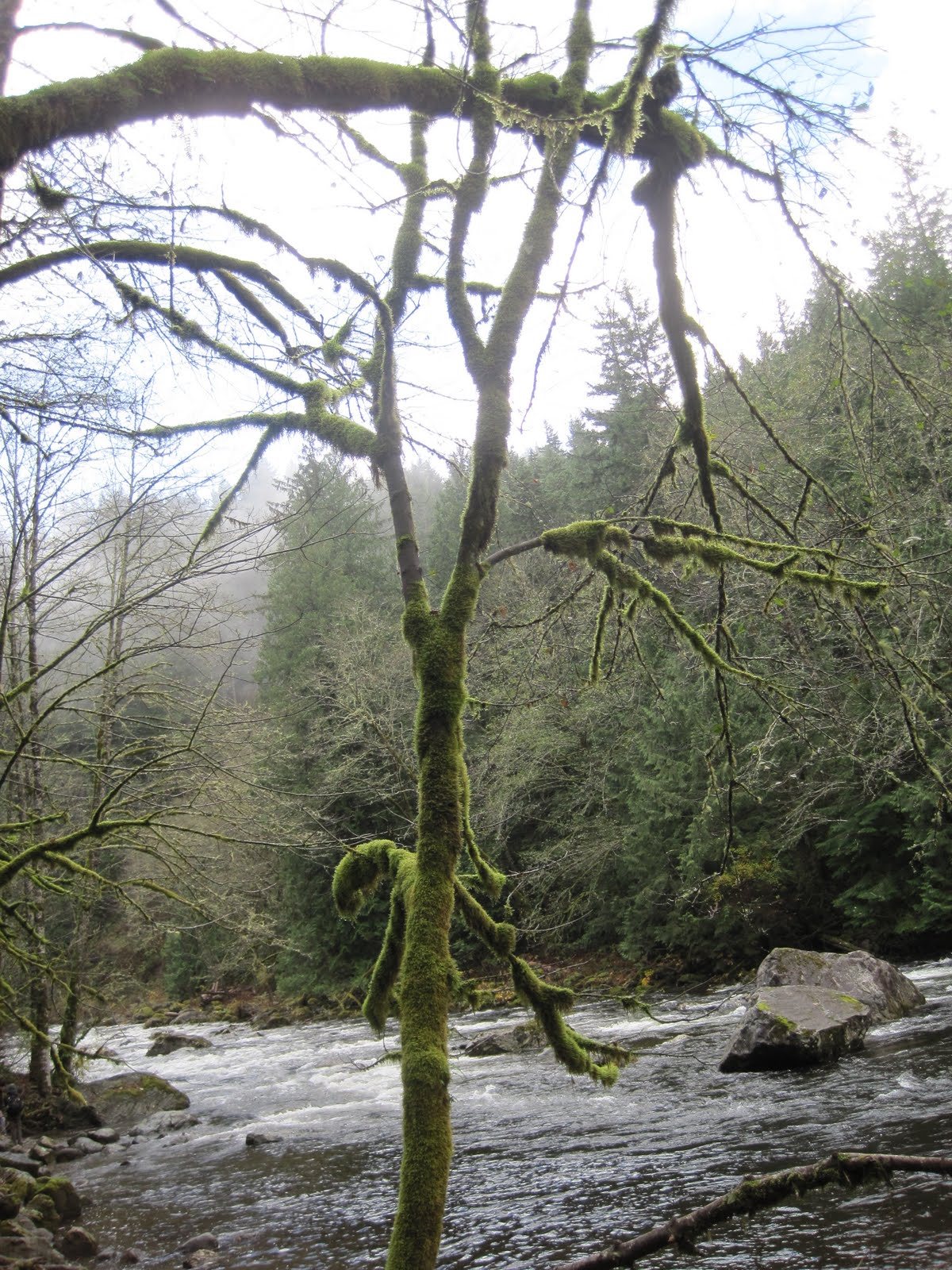
Everything was soggy and dripping. Moss was everywhere including covering the limbs of most of the trees in rain forest fashion. Mushrooms are still making their appearances.


This hillside of stone was covered in mosses and Maidenhair fern. Maidenhair is uncommon and always a pretty find.


The climb begins in earnest about one mile in and so you could hear the roar of water. Right at that spot a warning sign is obviously placed to keep the curious on track and way from the slippery rock edges.


In places the hillside gave way to runoff and trickling water organizes into small cascades.


Pretty soon there are many of them and the roar is getting louder. You enter an elevated walkway to cross over the river to see the first falls.


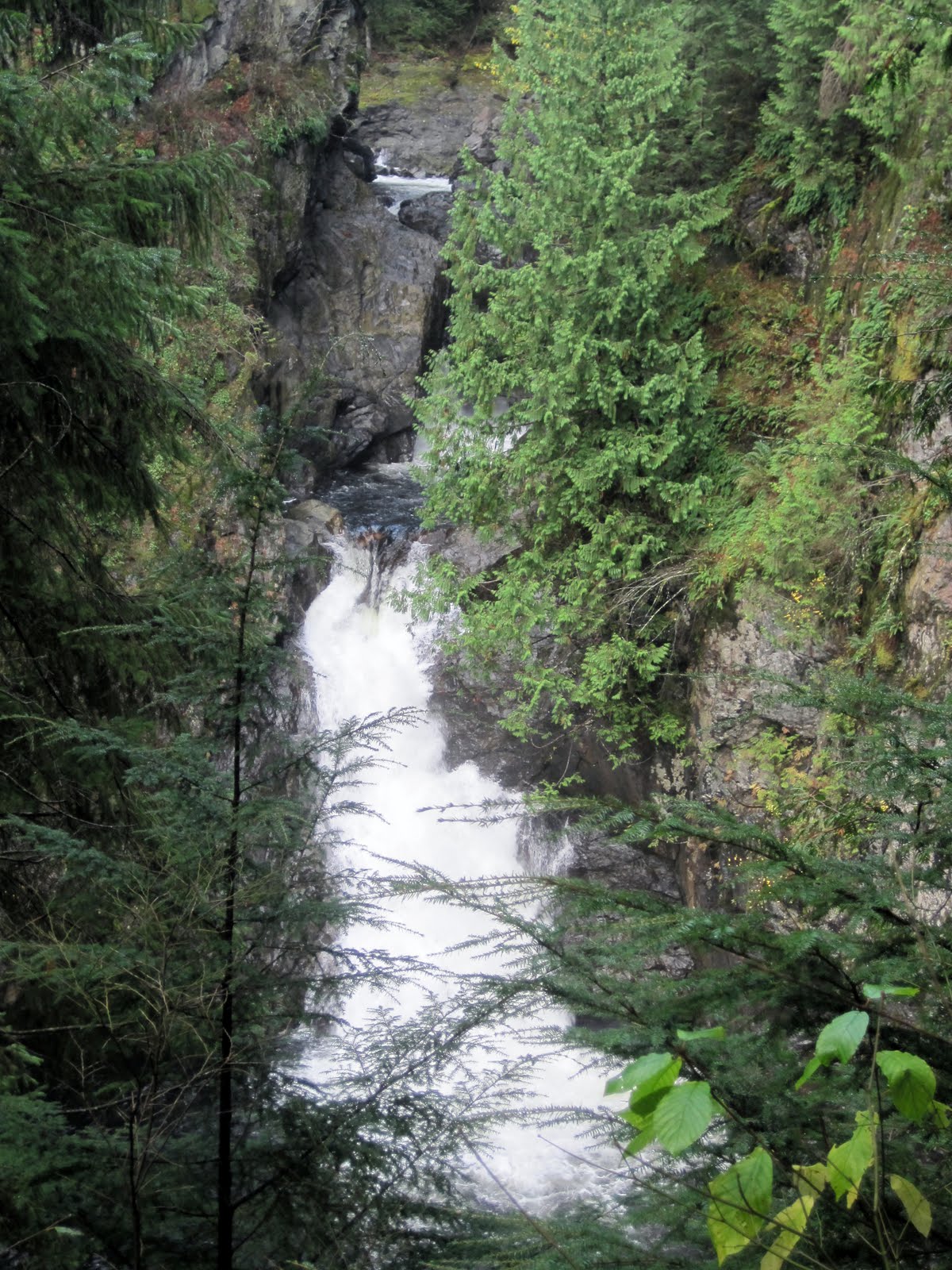
It is impossible to capture the height of the falls and the narrowness of the canyon. I estimate the main fall is about 50 feet and several smaller one disappear in the background.


I thought this rock face looked like an old ogre having a drink. :-D


Turning the other direction you see downstream. The edge of the river shows where the second falls start.


And here is the second falls from the observation platform below.


It is impossible to capture the whole 150 foot height plus the plunge pool. It is a dazzling beauty.


Walking back along the river I noticed this event in the making. The tree root have been exposed by a series of water events. It lookslike one good high water flood will send the tree toppling into the river.


The dilemma is that the upper fork of this tree holds up a pretty good leaner. That leaning tree juts out from the trails edge. I predict if the support goes the other tree will follow and undermine a bit of the trail edge. We will see!


This was a nice little walk, a quick journey between the rainfall. We are lucky here in King County to have a bounty of nearby hikes that can take us into these wonderful areas in a short amount of time. You can often hear I-90 roaring above you. That sound trades off with the running of the river. I imagine, in Spring, the singing birds add to the mix. This day I only saw one bird, a Pacific Wren (Winter Wren).


Another bonus in these hikes near to home along the I-90 corridor is the easy access to places for mid-day snackery like Macky Dim Sum in Issaquah. A plate of soup dumplings hits the spot.

Saturday, October 23, 2010

?u'lal

Saturday, I attended an interesting presentation on Cattail reeds at the Mercer Slough Nature Center. This facility is shared between the Bellevue Parks and the Pacific Science Center. Located just south of the downtown core, along the freeway it exists as a preserved area of rare environment.


The facility is beautiful and blends into the environment. The original education center was a house moved to the property years ago. The new buildings hang on the hill and there are walkways and viewing towers.


Filed with light and wood, the floor was stunning.


When Lake Washington was lowered as a result of digging the Ship canal, several native habitats were lost. Sloughs and marshes were waters from the creeks and streams ran into the river were lost and diverted. The whole Black River, which connected the Cedar to the Duwamish disappeared. The Cedar was channeled through a canal to the lake. The Mercer Slough is being protected as an important habitat for plants fish and wildlife. It is also the location of the settlement Sah tsu khal.


There has been historic settlements on these waterways for thousands of years. The Duwamish people inhabited settlements at the slough all along Lake Washington, Lake Union and the Black River and the Duwamish rivers. The clan was powerful, controlling commerce and transport of goods coming in from over the mountain. Chief Seattle was a member then leader of this tribe. Duwamish means "People of the Inside"


Much of the culture was centered on the use of both fresh water and salt water resources. The Lake People used the resources of Lake Washington , Lake Sammamish and the large rivers. Canoes of different types were made. Small canoes were used to maneuver in the calm waters and rivers, handy for getting into low water marshes. Larger salt water craft were for rougher waters and the long distance travel across and north and south along Puget Sound.


Tom Speer began the presentation with a welcome dance and song from the youth group and many member adults joined in. He then told the story of Little Silver Salmon.


Now is the time for this story since Silver Salmon go upstream when the Big-leaf Maple leaves fall. Here is an image of part of the story in Lushootseed and English. Tom told the story in both languages.


There was discussion of the use of cattail reeds for weaving. These mats formed the walls within the longhouses which were homes for extended multi-family groups. During the summer the population would become more mobile. They moved throughout the region working the land for harvesting and trade. Their houses were portable pole structures with the reed mats serving as walls and ceiling.


Mary Lou Slaughter was present and she demonstrated her craft of weaving and clothing production. Cattails are harvested in the late Summer and early Fall. Fine reed ends were stripped and formed into twine. The reeds are woven in a familiar fashion to make baskets.


The mats are made with a technique that is more like sewing. The reeds are laid long ways and a long wood needle was used to pierce through the reeds. D"Ann , an apprentice weaver demonstrated.


A cord was drawn though to bind the reeds together. A grooved mat presser, which matches the dowel, presses the reeds to prevent ripping.


Mary Lou is holding a bundle of reed twine she had worked on. Notice her shirt and the caption. Lushootseed for cattail, it is today's title.


Bark and abalone hat


Mary Lou was working on this Reed Vest


This shows you the needle part way along, the traditional double headed reed presser and the previous row and cording.


There were other items presented. I loved the cod fish lure. It is about eight inches long.


The little graphic shows how it works. Pushed down into the depths and let go, the whirling lure catches the fishes attention and draws it upward.


You can learn more here http://www.duwamishtribe.org/ about the tribes history and their current struggle to gain recognition.


Here you will find information on the Lushootseed language. Not having the proper program to type the font used in this language , our title today is the best I can do to write "cattail" in Lushootseed language.