About Me

My photo
Just a meandering soul sharing my backyard. Visit my Flickr page too! www.flickr.com/photos/meanderingwa/
Showing posts with label Kittitas county. Show all posts

Monday, April 14, 2014

Dry Run

A perfect, glorious day means getting out for that first taste of the dry side.  My first thought was to go looking for blooming cactus.  My GPS had other ideas, however.  The cactus area is remote and trackless, for the most part.  While I am pretty familiar with the spot, I like having the GPS to leave a "breadcrumb trail" so that option was out for the day.  My secondary reason for a good solid hike was to field test my new hiking shoes.  I needed a pair of low profile (below the ankle, lighter weight) sturdy hiking shoes.  My feet are not in the greatest of shape so I picked out a pair of shoes from the same maker of my hiking boots; Vasque.  I wanted to give them a good test-hike.  REI is glad to take back any footwear that does not work out and I need to commit to these shoes right away.

I decided to head over to the Ray Westberg trail outside Thorp.  This trail is popular with the folks in and around Ellensberg.  Early in the morning you meet a lot of runners and the occasional mountain biker.  The trail gains about 1700 feet and is 4 miles round trip.  I call that a good solid walk and a good test of the feet.  I will leave it to the younger or crazier to actually run up this trail.

Nature study is a great excuse to stop and pause during such a walk.

This area is Shrub-steppe with a sprinkling of Ponderosa Pine woodlands in some areas of the slopes.  I have wandered here quite a bit and it is one of my favorite places.

The wildflowers are just getting started with Gold Star, Crocidium multicaule and Grass Widows (Blue-eyed grass) Sisyrinchium angustifolim the major players at the start of the hike.  I didn't think I would get to see the Grass Widows and they are often passed by now, but there were still plenty to enjoy.


One thing about blooming flowers is that they are adored by bugs.  These little polka-dotted bugs are ubiquitous in this area and I have never been able to get them identified.


There were hardly any butterflies out but I did meet a few on my walk down the hill late in the morning.  I was thrilled to spot a green colored Hairstreak.  These butterflies are teeny tiny and I really gave a good try at getting a shot while one basked.  I was down in the dirt on forearms and knees and was just reaching in when it flittered off.  Impossible!  There is no other butterfly like this leafy green sweetie, barely bigger than a blouse button.

The Rabbit Brush and sage are not yet greened up and I found this little nest, a remnant from previous season.  It was very visible from the trail without the greenery to hide it.


The middle third of the trail is where you get above the surrounding slopes and you can see far and wide. Out here I started spotting Sagebrush Violet Viola trinervata, Bluebell Mertensia longiflora and Yellow Bells Fritillaria pudica. These three love the areas in and around the Rabbit Brush and sage and the shade they provide later in the month allows the bluebells to stick around quite a while.  All the flowers out right now are THE signs of Spring here.  Spring Beauty Claytonia lanceolata was just getting started in the high area of the trail where it is still a bit moist from melting snows.


I didn't spot any bluebirds at the nest boxes.  I noted that there are more boxes than in previous years. Stellers Jay were pretty noisy and it looked like possibly two different couples were squabbling about possible nesting areas in some of the Ponderosa Pine.  I also saw an American Kestrel sitting in a tree where in previous years I know there was nesting.  Western Meadowlark were starting to sing as I neared the upper area.  One of my favorite songs.

This little pee-wee chipmunk didn't move and inch while I shot some photos and passed by.  It may have had a nest near and I suspect freezing in place is a good tactic.


The first 2/3 of the trail is where the hard gain happens, then the upper 1/3 slopes up more gentle like until you reach the top.


There are many memorials up here to members of the community including a fair number of POW/MIA. Sitting here is always a peaceful time and such great views.

The Stewart range with Mt Stewart dominating.


The beautiful hay fields of Kittitas Valley.  My old trainer called this stuff "horse crack"


My New Shoes!!  <3 nbsp="">

After a brief sit it was back down , down , down...


...for I had a burger on my mind.  I love the Red Horse Diner good diner food in an old converted Mobile Gas station.  It is filled with a ton of gas station signs and a few old road signs from around the Kittitas Valley area.  The Van de Kamps Bakery sign is certainly one I remember from kid-hood


The dry side is always a good bet for fair weather.  Getting an early start to the day is key, for it wont be long when daytime temps climb into the upper 80's to 90's.

Tuesday, May 28, 2013

Neat Neat Neat

The dry side always calls me, particularly so in its very early and brief Spring.  The dry arid countryside holds little interest for many who fly through on the freeway.  For me it is a world of wonder.  It think what draws me is that it is so different from my home.  A few short hours and I am in a different country.

The area west of Vantage, just up from the Columbia River feels ancient and timeless.  It is hard country with bare rock and swift winds.  The wind turbines are taking advantage of these winds, generating power.


From a handy parking area on the highway you can strike out over the land or along many dirt roads.  It is a popular hunting area in the Winter, but during the other seasons bird watchers and flower seekers ramble the land.  There are many fair roads and motorcycles and bikes are a handy way to get out into the open range. Most cars are not useful here in the rutted broken roads

Flowers draw me.  I come here to see the Hedgehog Cactus in bloom.  I am also on the lookout for Bitterroot.  All over the dry slopes Meadowlark sing their wonderful gurgling song.  Such shy birds, getting a picture is next to impossible.   I am sure those birds who live in town are better models for the camera. 

I did not have any particular place in mind so I struck out on one of the roads.  the slopes were covered in Lupine , Balsamroot and Desert Parsleys.


I figured I needed to go someplace I had not been before so I decided to go over and see those basalt cliffs.  I simply walked straight for them, cross country.


Not content to take the easy way up I climbed up the narrow route to the left.  I was hoping to meet something interesting in the rocks.  Nothing was about.

I found this nifty water catcher.  Just two corrugated metal panels and a fiberglass basin.  I have never seen anything like it.


I found an old water trough half filled with water and growing some kind of green duckweed.  On a stick just breaking the surface, a small butterfly was very polite and allowed me to get a few pictures.  There are many small blue butterflies; collectively called "Blues".  My tentative id of this one is Silvery Blue .


I rambled for some time keeping my eyes out for cactus.  They are predictable in their preference for rocky broken rocky areas.  Being small and close to the ground when they are young and not in bloom it is easy to mistake them for a rock.  I hate stepping on the little ones.  The bigger ones are simple to spot.


Cannot miss these.


Bitterroot seemed to be missing this day.  Perhaps I was simply in the wrong spot.  I made my way back towards the parking area into an area I knew fairly well.  It was not long before I spotted some choice blooms. 

Lewisia rediviva ; restored to life.  This, I feel, is our most beautiful native flower.  Its small buds push up through the hard soil, often from under rocks.  Easy to step on those fragile buds. 

I walked along the road with my eyes down.  Not content with just one random blossom.

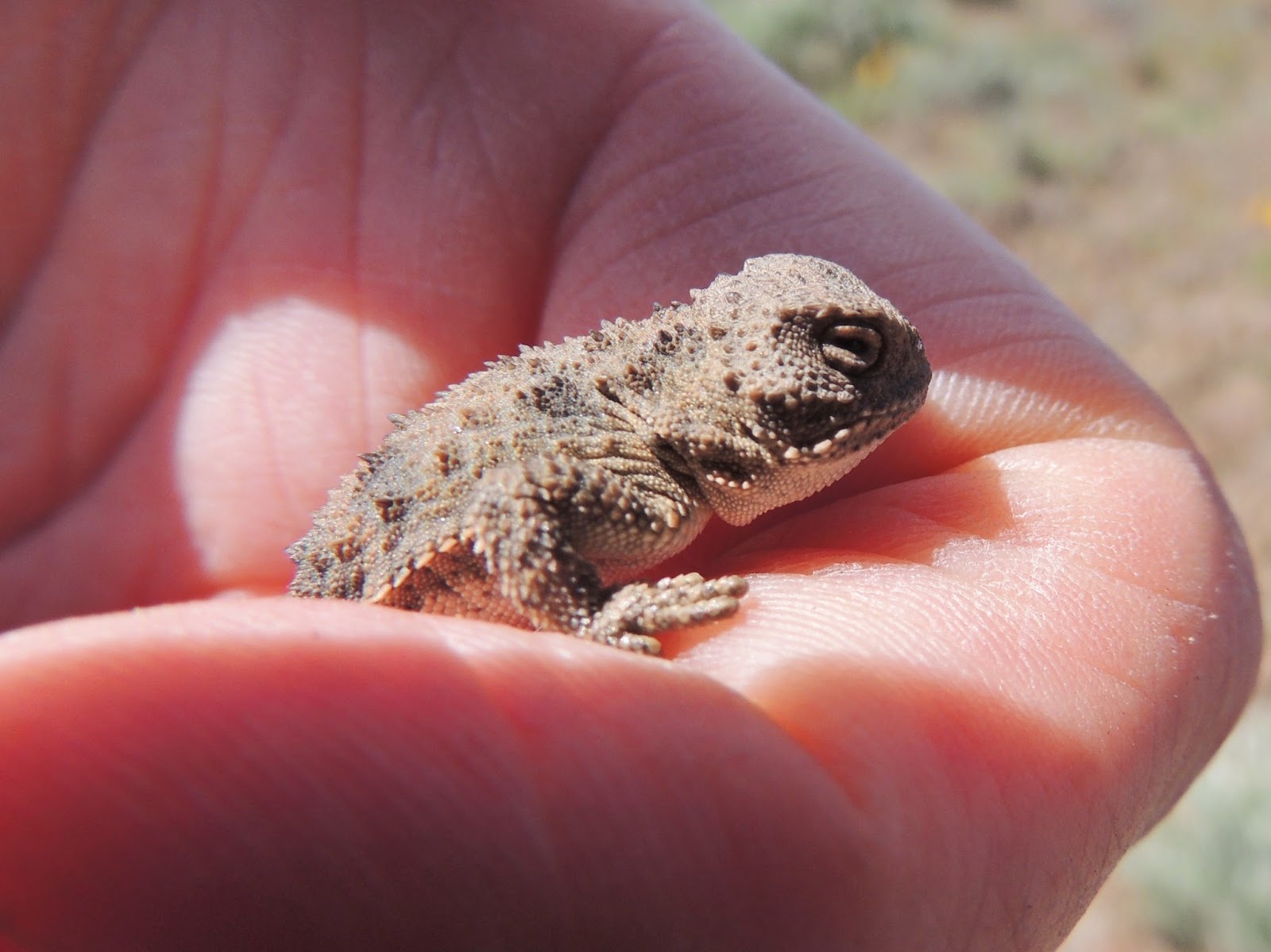
Then I saw something move in front of me.  I wasn't going to make a hunt but I could not leave it be.  I quickly got my camera at the ready and got on my hands and knees  (in the wilderness no one can hear you say "oof")

I see you


A Pygmy short-horned lizard (Phrynosoma douglassii) aka horned toad.  It could not have been more than 3 inches long including tail.  Probably young, they top out at 5 inches


This is the good stuff.

Neat neat neat

Monday, February 20, 2012

S ~ Sandhill Crane


Grus canadensis

Sandhill Cranes are found in many areas of eastern Washington, and in small numbers during migration and Winter in western Washington.  This picture was taken up on the Uptanum, just south from the lonely cabin in my Kittitas post.  I surprised these two birds and they were most unexpected in this location.

Further east, in the town of Othello, the cranes are welcomed each Spring during their migration.  It is a time when this town is able to showcase the rich ecology and habitat of pothole lakes and meadowed grasslands which these birds favor.  To see thousands of these large, impressive birds coming in to night roost is an experience never forgotten.  You heard their loud trumpeting, rolling calls before you see them.  They have a wing span of up to 7 feet and when there are hundreds passing over in effortless flight you are reminded of their dinosaur ancestry.

Pairs bond strongly and cranes all over the world are known for their dancing courtship displays.  Pairs and their young may remain in the family group for up to 10 months. 

Saturday, February 11, 2012

K ~ Kittitas


Kittitas


Kittitas county , located on the east side of the Cascade slope is the heart of Washington state. Its ecology ranges from high mountain and conifer forests to sagebrush steppe and upland grasslands. In the heart of the county irrigation farming supports one of the best hay growing acreage in the United States.

To the north the county is dominated by the Stewart Range (Mt Stewart 9415 ft) and the geologically distinct Wenatchee Lobe. The plant life of this high altitude region is filled with diverse species found few other places in the world.

I have spent many hours exploring the county and I return to it over and over as I can drive 1 ½ hour from home and be in a place so high and quiet that the beat of my own heart is too noisy.

Quite a number of photos in this month’s project were taken in Kittitas. This photo is taken from Umtanum Road above Ellensberg. This high plateau is currently home to the L.T. Murray Wildlife Management Area . In the late 1800 and early 1900 this area was farmed and ranched for wheat.

Sunday, May 29, 2011

Kittitas County Ramble

Using Professor Mass' blog and YouTube pod cast I knew the only open weather for Saturday was going to be Kittitas. How lucky I am that the center of our state is one of my favorite places to explore.


I decided to go where I would. I knew that I was not going to be able to get back for some time and I knew I have missed some of the best of the far dry side. I got up super early to get on the road.


My first stop is one of my favorite places, Elk Heights. This spot along the freeway is where the pine forests and hills give way to the basalt flows and grasslands of the dry side. As always the wind was ripping here and its temperature reminded me that they are still skiing some places in the mountains. Brrr. But who can resist Balsamroot and lupins in the fields.


I took the surface road along the Thorp Prairie and got a close up look at some of the farms and houses that have clearly been here over 100 years. Behind this barn complex the land gives way to a deep cut in the basalt. This Hwy 10 road used to be the main east west highway through the state. The Thorp area and the land to the east through Ellensberg supports some of the best hay agriculture in the country. The hay here is rich and plentiful. It is also huge business. Much of the product gets placed directly into shipping containers and winds up in the best barns in the far Pacific Rim. The hay for the Sydney Olympics came from this valley.


By the time I got to Ellensberg I could see the wind turbines and noted that they were barely turning. I know they can choose to run them or not, but could I be in luck and have a calm day? If so I knew there is not time like now to get up to the Colockum Management Area along Hwy 10 and sleuth out some of the fun plants of the dry side.


There were several trucks and trailers with off-road vehicles. Over the way a lone woman appeared to be weeding or picking something. As I walked near I saw the cross I had noted before. She was cleaning bits from around it. Hand made, sprayed in Camo with name and date of one far too young. The woman could be his mother. I was reminded that this Memorial Day means there are outings missing some of the loved ones. I have to imagine this young man once roamed these hills on his motorcycle. She did not look up and I did not disturb her in her loving task.


The area was nicely quiet and with no wind I felt that my foot falls were making far too much sound. My binocular straps are on swivel clips that squeak and chirp. Sometimes they make me stop and wonder who is behind me.


But I could hear music. My Pavarotti! A Sage Thrasher sang his run-on song; on and on like an aria. Lovely warbling all over the scale, it always sounds ever so slightly rusty, as if he needs a drink.


I also heard a Western Meadowlark. The lone bird up on the slope acted like all Meadowlark when I am on foot. Flighty mistrusting and never willing to hold still. I don't know how I got so lucky to capture this one photo. I really had my lens zoomed up.


Birds never seem to be in the right position relative to sun light sky or background. That is what I thought would happen with this Loggerhead Shrike photo, but I am pleased to present him to you. This bird is also known as the " butcher bird". They capture bugs and impale them upon thorns and barbed wire spikes for safekeeping. His song is small , private chortles and chips.


Clearly all these birds have hopes for a happy nesting season.


I enjoyed being in a gully and looking up slope to see lovely big sky like this.


I hiked further north than usual and turned back to enjoy the ridge and how it changes as you go up slope and gain the top. This soil, in places is bare basalt rock and here I find Hedgehog Cactus.


Most of them are past bloom, others barely started ( like the above) , but I got lucky with this one. Bonus bugs too!


Dominating the ground here are the woolly-pod vetches / locoweeds (Astragalus) and Buckwheats (Eriogonum). These are an annoying array of plants that take tons of study to get to know. I am usually content to recognize them for what clan they belong to. The Buckwheats are favorite flowers of many of our butterflies. While the wind was not blowing I was not seeing much in the way of butterflies. I know they like to fly at certain times of day. Around here seeking out wet areas and mud pans is a great way to capture pictures. I kept hoping the clouds would break and warm the area enough, perhaps drawing the bugs out of hiding. Nothing ever happened.


I was content to wander up over the ridge looking for the prize I knew should be here. I was not disappointed. The Bitterroot are just coming into bloom and I found many. This will likely be my only chance for the year and once again, I know my love of this flower is justified.


Rediviva, reborn


The roots spring back to life when soaked in Spring rains and the succulent stems support the tough buds as they break out of the dry , crusty lithosoils.


I walked further east than usual and enjoyed the down slope of the ridge. Where the slop develops a pitch the soil gains moisture and the grasses start again. Here, looking east I can just make out the other side of the Columbia River and where the agriculture area starts again. To the South I can hear occasional sounds of artillery on the Yakima Firing Range. It echos and bounces over these hills.


Rock outcrops break the south slope of this ridge and I looked for Horned Toads and other surprises but found none. Just more flowers,


Brodiaea , Tritelia


Rock Penstemon


Phacelia


and the every challenging daisy clan. I believe these are Townsendia


I headed back along Hwy 10 to Ellensberg and noted not very far from the ridge the pavement was soaking wet. It had poured rain not a mile from where I was. I wandered the roads back to Ellensberg stopping to admire this old barn.


Some of the fields flood up at this time of year when tiny creeks burst in the flats and the flooded fields support Wild Iris.


So it was a lovely slow type day. I needed something relaxing and not too challenging. It has been an intense, fast, busy couple of weeks. Even though it is a three day weekend, busy stuff and work calls on Sunday. Monday weather promises to be not that great but we will have to deal with that when it arrives.


Today I said good-by )( or rather "thanks" ) to a traveling companion of the last few years. I never met her, but she was always with me on Sunday morning. Liane Hansen of NPR retired after 22 years of sharing Sunday Morning with us. I knew I could count on her to tell me something new and share The Puzzle with me. Her voice carried me along over many miles.


Have a lovely "retirement" Liane, you will be missed. I hope your new road is filled with many adventures and wonderful discoveries.


To you all, I say goodbye for a few weeks. I too am off on an adventure.


Someplace like here...only different.

Friday, December 31, 2010

2010 Treasures

I often bring home an item that catches my eye. I place them in a pottery plate on the table.

Here is a picture of some of the treasures I found this year.


The Raven feather is a real find, 13 inches long. An owl left the large brown feather.

The starfish I found on Chuckanut Mountain. It was probably dropped by a crow.

You probably remember the cat-tail reed weaver and can spot the little duck.

There is a flake of tree bark with perfect sapsucker holes, still intact, at about 1:00. Next to it is a bit of sea plant that I brought home from Shi Shi Beach.

That is a little paper wasp nest at 12:00.

I love the nice blueish Serpentine rock I found in the Esmeralda Basin. (6:00)

The acorn was from the tree in front of my building. I do not remember seeing acorns from this tree. I collect acorns.


In moving them to a basket I found little items I have forgot I found.


I think that is a broken Killdeer eggshell. The seedpods from an interesting plant, Washington Twinpod, that started me on my Flickr membership. You can see the plant pods at full ripeness and their bloom from my Flickr page. You have to go all the way back to my very first entry.


http://www.flickr.com/photos/meanderingwa/


They are the oddest things I have ever found and certainly triggered my curiosity about the ecology of the Wenatchee Lobe and the Serpentine country of Kittitas county. We visited Professor Kruckebergs garden in November. He is an international expert in the ecology of this unique area of the state.

Have a wonderful , exciting 2011. Get out and explore your home, wherever it may be. I am off to work today then to a doctor for a Yellow Fever vaccine. That will be for an adventure later in the year. Someplace "Like Here Only Different".