This last Saturday I hopped out of bed early and headed over to Esmeralda basin to hike this trail once and for all. I knew it to be good for wildflowers and had previously visited the wet bog meadow near the trailhead. These meadows are filled with shooting stars, Elephant Head Lousewort and several of the Piperia orchid species
The drive takes about 2 1/2 hours and I always listen to NPR. As I cross over Snoqualmie Pass I change stations to Northwest Public Radio. This day I came in after the start of an interesting story about Pacific Lamprey.
http://www.nwpr.org/post/how-pacific-lamprey-could-help-nourish-streams
Lamprey , like salmon, are born in fresh water and go to sea. They return to spawn and it was here that our native peoples collected them for food and ritual. I didn't know about the Lamprey as a local freshwater creature. This day, the story was about the abrupt and rapid decline of a species that little is known about.
I love being on the road on the weekend when I can hear the NPR stations. I always learn something new.
Arriving at the trailhead, there were only two other people in the lot. Up the road, Esmeralda Basin trailheads were packed. I was content to take this less popular trail so I could enjoy the solitude.
I was rapidly disappointed, the first bog meadow was bone dry, the soil had little of the spongy goodness the plants need. I could see little evidence of flowers gone to seed, though I did not venture out into the meadow.
All along the way the flowers were well past. Pink Wintergreens was flourishing in the shady areas. They belong to the heath family and are pretty tough plants.
I also noted that Monkshood was flourishing in some of the smaller wet meadows. Anyplace that was near a water source had some Monkshood. Red Paintbrush was usually mixed in. They too are a pretty tough plant.
I pushed on, hoping that the higher elevation would yield soil that held on to snow longer. I was encouraged to see Trillium plants still showing their leaves.
The best thing about quiet trails early in the morning is that birds are often easy to spot. I got lucky today. First treat was a young Black-backed Woodpecker. This is a fairly uncommon bird and this youngster instantly started preening when I was trying to get a shot, so I had to content myself in a photo that just shows a peek of the yellow feathers on the forehead.
This little peanut was fast but a bit more obvious. No wren can every be near you without voicing its opinion of you. Pacific Wren ( formerly called Winter Wren, here) will often answer my ' chuck chuck" imitation of their call. This little one, looks a bit raggedy, perhaps it just had a bath. It might be this years youngster.
But the best meeting of the day was this fine male Western Tanager. He obviously had a nest near by. He held his ground and scolded me. Notice he is carrying food, a sure sign of a nest. Bonus points to the Sun for being in the right place at the right time to fill him with glory.
The trail up to Gallagher Head lake is 4.5 miles and has a pretty nice gain. Not so hard that you hate it and there is a lot of nice scenery to enjoy. When the flowers are up, it is glorious. I did find some Piperia orchids in several places and as I gained elevation, other flower species showed that their bloom season was not quite over. Mostly past, but still holding on.
What I really noted is that all the huckleberry bushes were mostly devoid of berries. What few berries were on were still somewhat red. I don't know if pickers have been through already or if the animals and birds are feeding. I usually associate these berries with later August or September. I have a favorite spot on the trail to Kendall Katwalk, perhaps that needs to be on the list for the next weekend or so.
As I gained I was delighted that the butterflies were quite active. Fritillary were most numerous. I was quite happy to capture Mormon
and Hydaspe
Any patch of mud is sure to have any number of Blues. Our area support many of these tiny Blue species and they are toughies to sort out for identification.
This little one was a new sighting for me. I studied my id book but still cannot decide if it is a Dotted/Square Spotted Blue quite worn, or perhaps some other species I totally don't know.
It was pretty warm so getting to the lake was a welcome stopping spot.
I sat on a log and enjoyed a snack. Up here, the Spring thaw took a little longer so I did find one of my favorite flowers, Elephant Head Lousewort. They were largely past and those remaining were not as bountiful in flower heads as you can often find, but I was happy to see them. How can you not smile at purple elephants
The trail down always goes faster than the trail up. The breeze had picked up and many of the butterflies were really zipping around. Joining the fritillary were the parnassians. I was pretty thrilled to get this shot. The bistort was swinging in the wind, but the Clodius Parnassian was holding tight and feeding eagerly.
I always check out certain flowers for bug. Some plants are bug magnets and the lovage did not let me down. This is a Yellow Velvet Long-horned Beetle. It really glistened and looks like it had a coat of shiny velvet flocking.
Once again our area is on fire. The area of the Colockum, where I like to go for early Spring cactus and bitterroot prowling is roaring with fire. Sadly some historic ruined buildings from the days of ranching in the late 1800 early 1900 will likely be lost.
Even in my own neighborhood, the Mt Si fire was obvious from the freeway. This little fire was trivial compared to those burning east of the mountains.
Rain was welcome these last few days, tomorrow promises an improving weather pattern.
Ramblings around Washington State. Natural wonders of my world. I am forever trying to learn. Strong caution, pictures of plants may include bugs,spiders and other "creepy" things. Natural history plants flowers bugs birds biologies. Geology weather conservation and gentle hikes.
About Me
- Upupaepops
- Just a meandering soul sharing my backyard. Visit my Flickr page too! www.flickr.com/photos/meanderingwa/
Showing posts with label bird. Show all posts
Saturday, August 3, 2013
Sunday, June 2, 2013
Colorful Day
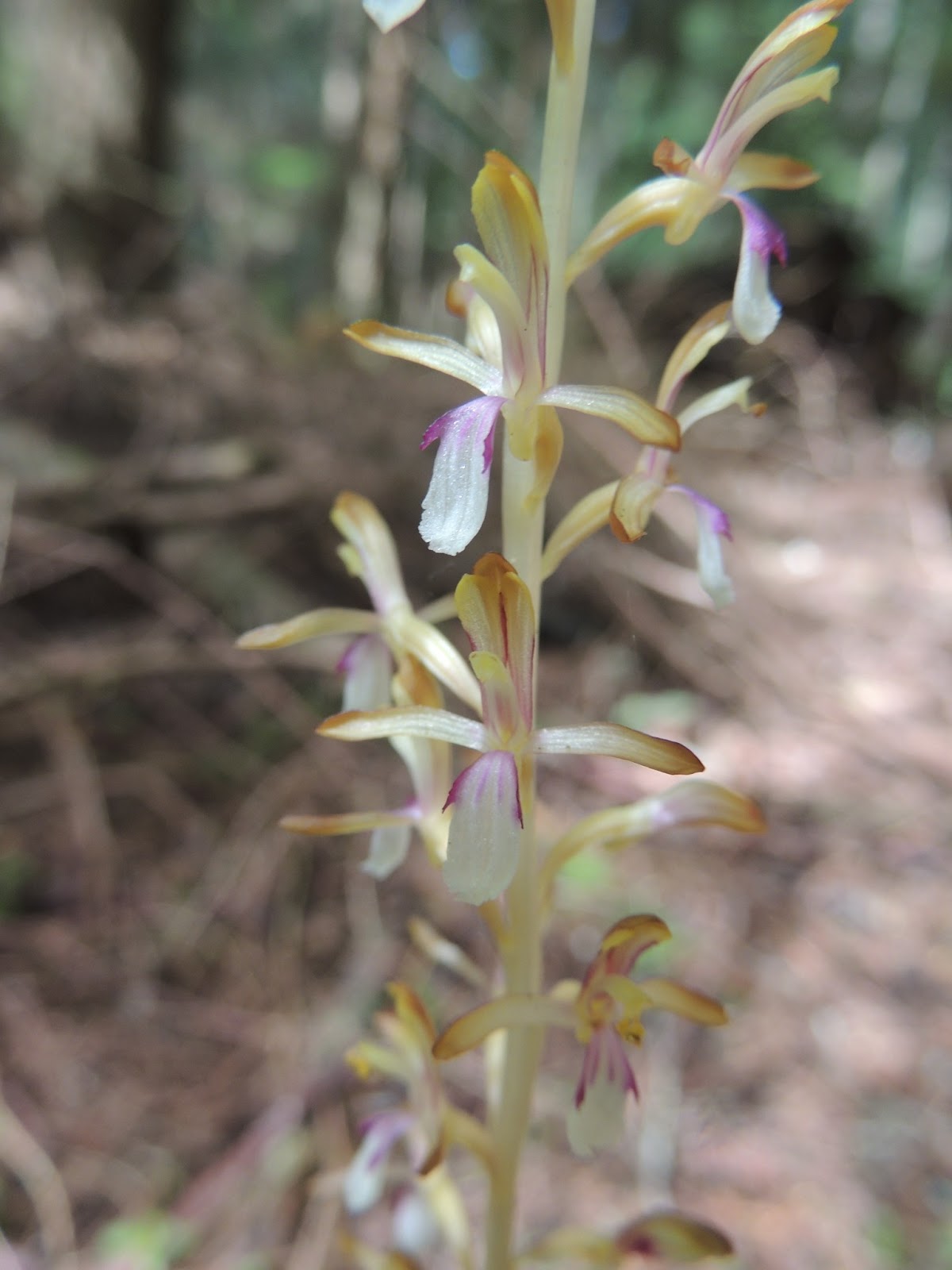
Made a quick escape to Hoypus Hill on North Whidbey Island. Coralroot orchids were the target and one rare type, the Ozette was the desire of my hunt. Sorry to say I did not locate the Ozette I had found there before but it was a pretty day out. It was very unexpectedly warm and sunny. I entered the woods to gray cloudy skies and exited to sharp blue and clear.
Magenta
Western Coralroot (Corallorhiza maculata) orchid
Creamy yellow : a pale form of the Western Coralroot
Red : Net-winged Beetle (Dictyopterus simplicipes) on a Douglas Fir cone
Neapolitan : Spotted Towhee (Pipilo maculatus)
Orange : Butt view of a Bombus bee in Orange Honeysuckle( Lonicera ciliosa)
Green: Deer Fern (Blechnum spicant)
Rust : Song Sparrow ( Melospiza melodia) gathering food for nestlings. 2 small wormy bits in the bill
Purple : Purple Martins (Progne subis) nesting at the marina at Hoypus Hill. This is the female ( male behind) at their nest box
Male Purple Martin
Tasty Color: Sweet D's Shrimp Shack is open for the season. New this year an inside dining area and a BBQ pit.
Fresh Coon-striped Shrimp
Artfully colorful: The Tri Dee Art Supply store in Mt Vernon. The I-5 detour ( southbound from Anacortes) takes you past the store.
Magenta
Western Coralroot (Corallorhiza maculata) orchid
Creamy yellow : a pale form of the Western Coralroot
Red : Net-winged Beetle (Dictyopterus simplicipes) on a Douglas Fir cone
Neapolitan : Spotted Towhee (Pipilo maculatus)
Orange : Butt view of a Bombus bee in Orange Honeysuckle( Lonicera ciliosa)
Green: Deer Fern (Blechnum spicant)
Rust : Song Sparrow ( Melospiza melodia) gathering food for nestlings. 2 small wormy bits in the bill
Purple : Purple Martins (Progne subis) nesting at the marina at Hoypus Hill. This is the female ( male behind) at their nest box
Male Purple Martin
Tasty Color: Sweet D's Shrimp Shack is open for the season. New this year an inside dining area and a BBQ pit.
Fresh Coon-striped Shrimp
Artfully colorful: The Tri Dee Art Supply store in Mt Vernon. The I-5 detour ( southbound from Anacortes) takes you past the store.
Labels:
bird,
Hoypus Hill,
Orange Honeysuckle,
purple martin,
Song Sparrow,
Spotted Towhee,
Washington nature,
western coralroot,
Whidbey Island
Location:
Oak Harbor, WA, USA
Monday, February 27, 2012
Z ~ Zonotrichia leucophyrus , White-crowned sparrow
This is, without a doubt, one of my favorite bird photos.
The White-crowned sparrow is a harbinger of Spring. The males perch up on shrubs trees and just about anyplace and sing their sweet song...
"I'm a Pretty little bird(ie).
In different regions of North America this birds song will vary. Sometimes buzzy or rusty sounding, other times clipping off syllables of the phrase. I think the "I'm a pretty little birdie" is unique to the Puget Sound and Vancouver BC area.
To me it is a sure sign of Spring. The males should be showing up in the next three weeks or so.
I think they come on the same bus as the Rufous Hummingbirds.
Monday, February 20, 2012
S ~ Sandhill Crane
Grus canadensis
Sandhill Cranes are found in many areas of eastern Washington, and in small numbers during migration and Winter in western Washington. This picture was taken up on the Uptanum, just south from the lonely cabin in my Kittitas post. I surprised these two birds and they were most unexpected in this location.
Further east, in the town of Othello, the cranes are welcomed each Spring during their migration. It is a time when this town is able to showcase the rich ecology and habitat of pothole lakes and meadowed grasslands which these birds favor. To see thousands of these large, impressive birds coming in to night roost is an experience never forgotten. You heard their loud trumpeting, rolling calls before you see them. They have a wing span of up to 7 feet and when there are hundreds passing over in effortless flight you are reminded of their dinosaur ancestry.
Pairs bond strongly and cranes all over the world are known for their dancing courtship displays. Pairs and their young may remain in the family group for up to 10 months.
Labels:
A to Z,
bird,
crane,
Grus canadensis,
Kittitas county,
Sandhill Crane,
Umptanum,
Washington nature
Monday, February 13, 2012
M ~ Melospiza melodia , Song Sparrow
Melospiza melodia , Song Sparrow
The most common and widespread of the sparrows in the United States, Song Sparrows can be found and heard in most every open grassy or brushy habitat. They are very sociable and are regularly found in city back yards as well as isolated mountain forest edges and meadows. Here in Washington most of our birds are well marked and favor russet and white colors. Much of the streaking is over-washed with a bluish gray blush.
Song Sparrows are so common that they are often used to relate bird size when in the field. In discussion with another birder it would be common to say that a bird is bigger then or smaller than a Song Sparrow. Other birds that serve as a size standard are American Robin , chickadee and pigeon ( Rock Dove) and American Crow.
Labels:
A to Z,
bird,
Kubota Garden,
Melospiza melodia,
sing,
Song Sparrow,
sparrow,
Washington nature
Friday, December 3, 2010
Subscribe to:
Posts (Atom)