I took Lil Blue out for a spin along the Snoqualmie River Trail, Duvall to Carnation.
It was super early to beat the heat and I pretty much had the trail to myself. The air was almost chilly to start
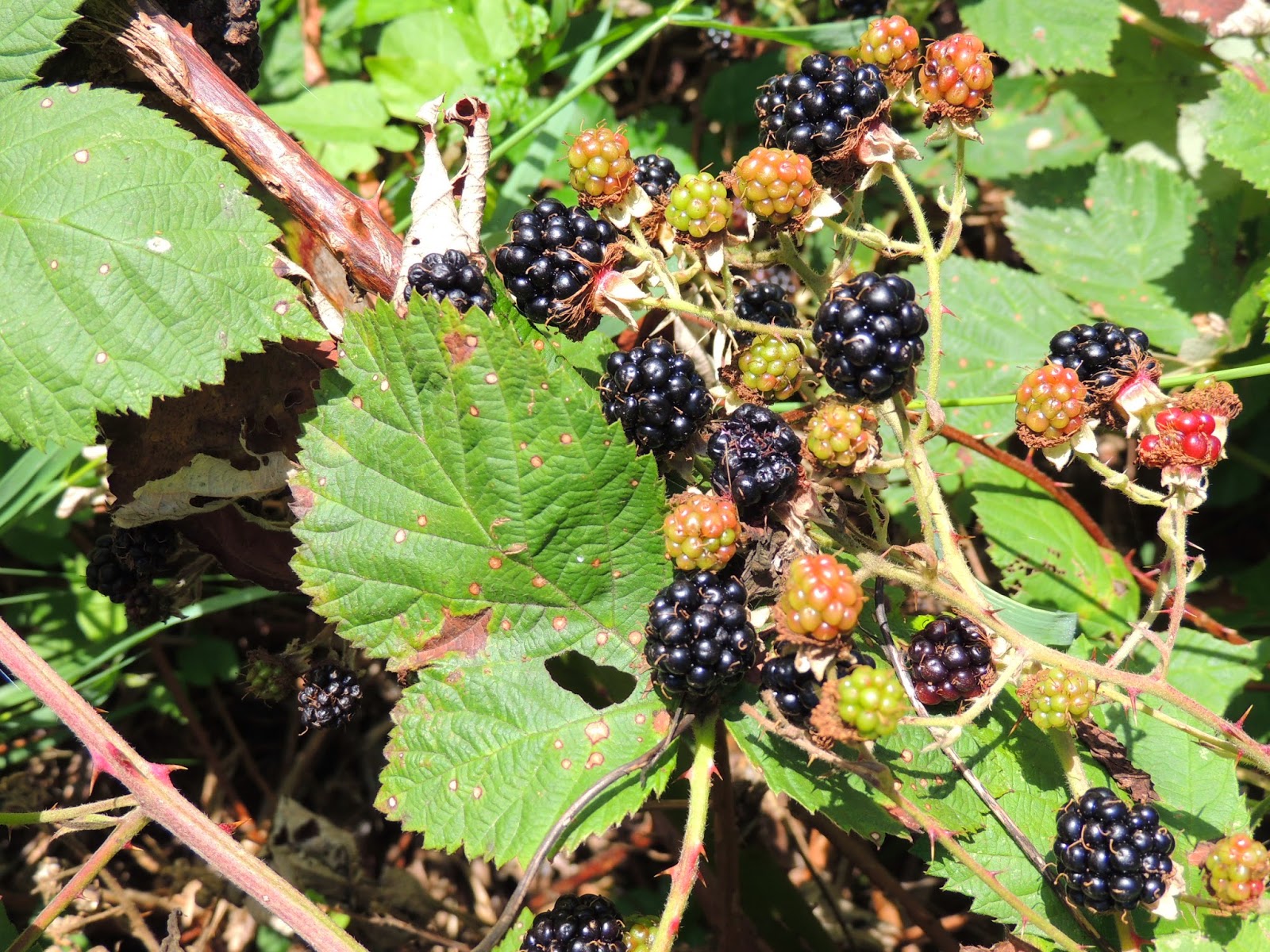
Along the way I noted the bounty of Blackberry, always present in areas like this.
I think it is going to be a banner year. Many berries already dark and needing just another week of hot sunny day to convert those sugars and loosen up. The forecast is for a good solid week of no rain, so first pick should be next weekend.
After first pick, which will go into flavored vodka making, there will be waves and waves of berries to come on. Today I note plenty of green and red berries, enough to make a long season
Birds were everywhere and Robins lead the way. They gorge on these berries and I saw some evidence that Coyote were here about as well.
Peter Rabbit was plotting his attack on the bounty too. Cottontails dashed and darted across the trail.
I peddled into Carnation and stopped for a decaf (aren't I wild ) before beginning the five miles back. Along the way I could feel that point where the rising sun had burned off enough fog and it was the start of another warm day.
Ramblings around Washington State. Natural wonders of my world. I am forever trying to learn. Strong caution, pictures of plants may include bugs,spiders and other "creepy" things. Natural history plants flowers bugs birds biologies. Geology weather conservation and gentle hikes.
About Me
- Upupaepops
- Just a meandering soul sharing my backyard. Visit my Flickr page too! www.flickr.com/photos/meanderingwa/
Showing posts with label Nature. Show all posts
Sunday, July 27, 2014
Berry Scouting
Labels:
blackberry,
cottontail,
Nature,
Summer,
washington
Location:
King County, WA, USA
Sunday, May 25, 2014
Like Here, Only Different ~ There's A Hole In The Bottom Of The Sea
This has been a long day on the Golden Circle Tour.
I could only pick one activity and I wanted to get out and see nature and the marvels of this land. This tour gives only a little taste, but what a taste it is
https://www.re.is/day-tours/the-golden-circle
This is a day with a bit of variety.
We started with a visit to a geothermal greenhouse and see how fresh vegetables are grown year round using the natural heat generated from the volcanic resources. Sorry about the photo orientation.
Plant seedlings are started in a separate greenhouse then brought into the planters with more mature plants.
The greenhouse is heated with geothermal heat and the water is processed secondarily. Lights are also powered with geothermal and turbine generated power. The plants are not hydroponic, but are rooted into large peat bales. Water is dripped into the bails and runoff is collected and recycled.
Vines climb 25cm per week and when in production, the tomatoes are harvested, packaged and transported to town every day.
Bees are brought in from Belgium and used for pollination. The are charming, fat round and fuzzy, unlike our common honeybee. They produce small bulbous cones and the owner says they sometimes make use of the small amount of tomato honey. Parasitic wasps help keep flies out of the fruit.
Completely organic and very environmentally sound.
Gullfoss (golden falls) is a magnificent waterfall dropping staircase fashion and appearing to disappear.
The Wiki page has some wonderful photos of the winter falls, which must be something to see
http://en.wikipedia.org/wiki/Gullfoss
The falls cascade down with amazing flow and speed. As there was freezing in the mountains last week, I assume the Spring run off is just getting underway.
Early in the 1900s this area was under speculation for a damming. One young woman who lived nearby fought very hard to have the areas natural wonders preserved. Her devotion was complete, including tracking to the city to meet with officials.
We stopped in Haukadalur to see geysers. Geysir is one of the larger ones and it is from it we get the general term. Geysir is derived from a word that means "to gush"
http://en.wikipedia.org/wiki/Haukadalur
Geyser itself no longer erupts like it once did. Earthquakes have changed its character.
Nearby Strokkur is reliable and erupts with high frequency.
The whole of the basin is filled with small thermal pools, springs and bubbling pots. Temperatures are around 90C, near boiling. Some of the thermal pools deposit minerals and are a stunning color, even on this stormy day.
Thingvellir National Park is where we find the hole from the bottom of the sea. Plate tectonics which create the Mid-Atlantic Rift rise from the ocean and cross Iceland. It is here that the North American Plate and the Eurasian plates are splitting apart by several centimeters per year.
There really is a hole. A long Tear Along The Dotted Line rift.
http://www.thingvellir.is/english.aspx
http://en.wikipedia.org/wiki/%C3%9Eingvellir
This is a crack of the Eurasian plate
This is the North American plate boundary.
People actually come and scuba dive in the cracks and chasms.
Thingvellir is the birthplace of Iceland. It is where the first people held Parliament. The word "thing" originated from this place word. "Thing" originally a word in abstract; talk and consider the subject / issue at hand. Only later did the word start to mean an item.
Getting out into the environment was a treat. It is wild, complex and ever changing. Moses, lichens short grasses dominate. Lupins are the main plant along with small shrubby trees which appear to be willow family. I even spotted some wild Viola
Icelandic Horses were seen frequently and we saw more of the sheep that produce wool. Most of the ewes have new lambs and it appears that twins are the norm.
Tomorrow it is time to return home and back to my work-a-day world.
It has been quite a time. Now it is time to dream up another adventure.
I could only pick one activity and I wanted to get out and see nature and the marvels of this land. This tour gives only a little taste, but what a taste it is
https://www.re.is/day-tours/the-golden-circle
This is a day with a bit of variety.
We started with a visit to a geothermal greenhouse and see how fresh vegetables are grown year round using the natural heat generated from the volcanic resources. Sorry about the photo orientation.
Plant seedlings are started in a separate greenhouse then brought into the planters with more mature plants.
The greenhouse is heated with geothermal heat and the water is processed secondarily. Lights are also powered with geothermal and turbine generated power. The plants are not hydroponic, but are rooted into large peat bales. Water is dripped into the bails and runoff is collected and recycled.
Vines climb 25cm per week and when in production, the tomatoes are harvested, packaged and transported to town every day.
Bees are brought in from Belgium and used for pollination. The are charming, fat round and fuzzy, unlike our common honeybee. They produce small bulbous cones and the owner says they sometimes make use of the small amount of tomato honey. Parasitic wasps help keep flies out of the fruit.
Completely organic and very environmentally sound.
Gullfoss (golden falls) is a magnificent waterfall dropping staircase fashion and appearing to disappear.
The Wiki page has some wonderful photos of the winter falls, which must be something to see
http://en.wikipedia.org/wiki/Gullfoss
The falls cascade down with amazing flow and speed. As there was freezing in the mountains last week, I assume the Spring run off is just getting underway.
Early in the 1900s this area was under speculation for a damming. One young woman who lived nearby fought very hard to have the areas natural wonders preserved. Her devotion was complete, including tracking to the city to meet with officials.
We stopped in Haukadalur to see geysers. Geysir is one of the larger ones and it is from it we get the general term. Geysir is derived from a word that means "to gush"
http://en.wikipedia.org/wiki/Haukadalur
Geyser itself no longer erupts like it once did. Earthquakes have changed its character.
Nearby Strokkur is reliable and erupts with high frequency.
The whole of the basin is filled with small thermal pools, springs and bubbling pots. Temperatures are around 90C, near boiling. Some of the thermal pools deposit minerals and are a stunning color, even on this stormy day.
Thingvellir National Park is where we find the hole from the bottom of the sea. Plate tectonics which create the Mid-Atlantic Rift rise from the ocean and cross Iceland. It is here that the North American Plate and the Eurasian plates are splitting apart by several centimeters per year.
There really is a hole. A long Tear Along The Dotted Line rift.
http://www.thingvellir.is/english.aspx
http://en.wikipedia.org/wiki/%C3%9Eingvellir
This is a crack of the Eurasian plate
This is the North American plate boundary.
People actually come and scuba dive in the cracks and chasms.
Thingvellir is the birthplace of Iceland. It is where the first people held Parliament. The word "thing" originated from this place word. "Thing" originally a word in abstract; talk and consider the subject / issue at hand. Only later did the word start to mean an item.
Getting out into the environment was a treat. It is wild, complex and ever changing. Moses, lichens short grasses dominate. Lupins are the main plant along with small shrubby trees which appear to be willow family. I even spotted some wild Viola
Icelandic Horses were seen frequently and we saw more of the sheep that produce wool. Most of the ewes have new lambs and it appears that twins are the norm.
Tomorrow it is time to return home and back to my work-a-day world.
It has been quite a time. Now it is time to dream up another adventure.
Labels:
geothermal,
geysir,
Golden circle,
Gullfoss,
Haukadalur,
Iceland,
Nature,
Thingvellir,
vacation
Location:
South, Iceland
Wednesday, March 19, 2014
More Burlaping
Last weekend I spent a morning with the Nisqually Land Trust placing burlap on a riverside property in Yelm. This long, thin property has a home on it and staff members of the Land Trust have lived here over the years. In its former life it was a riding stable. Most of the evidence of that past life has gone. There is one clearing where the old sand arena has given over to soil and supports a healthy growth of young Cottonwood and cedar.
Today we hiked in about 15 minutes and fanned out, placing burlap over the invasive Reed Canary Grass. After letting this grassy area die back a bit, native trees and shrubs will be placed.
This area was a bit tricky. It is near the river and there are a few small water paths cutting through it. In the thick grass it is a little challenging to see. Also buried under the grass are many small fallen trees. Some I assume are wind-tossed but I would not be surprised to find that some local residents did some of the cutting.
Beavers, this property has beavers. They love hardwood; alder, maple and the like. They will not eat conifer. This does not stop them from damaging the trees however. They will methodically girdle the conifers in order to kill the trees and increase the sunlight, boosting the growth of favorable trees. The Land Trust has tried to protect as many of the conifers along the property as they could, but resources are limited.
These roots and trunk have been girdled. Some smaller, recently planted trees at the front of the property have had their trunks painted with a pasty mixture containing sand. This makes a sandpaper like coating and the Beavers avoid it. For this old tree, it is too late.
The work was easy and fairly pleasant. There was a lot of dragging sacks from the stockpile out to the patch being worked on and back and forth again. Throw them down and piece the edges together like a huge quilt. Hands and knees crawling about type work. At one point I simply took a break and lay down and checked out the clouds. Pretty comfy.
We had a ton of singing woodland birds. Spring is clearly in the air. I heard many mating songs and chases. Brown Creepers wound up and down tree trunks in courtship and territory display.
Highlight for a few of us was a visit from a little charmer. He was in the grass and hopped onto the burlap we were in the process of placing. I cannot believe I was able to roll over grab my camera and sneak back for this terrific shot
A teeny , tiny Tree Frog, Hyla regilla. He is not much longer than 2 1/2 inches nose to bottom. He posed quite nicely for us. Chris, the volunteer coordinator observed that the bug life under the burlap gets quite robust and these frogs make a good living.
Three hours passes quickly. I can feel it in my hands they are simply not as healthy as they use to be.
The walk to and from the work sight was time to enjoy the first hints of Spring.
Early Blue Violet ; Viola adunca
Salmonberry ; Rubus spectabilis bringer of Rufus Hummingbirds.
Impossibly tiny puffballs. I didn't know what they were, for sure and after getting the pictures ventured to touch one. They dent slightly and did not puff any spores.
The prize of prizes
We spotted two Trillium ; Trillium oviatum . I don't remember ever seeing one this early!
The rains continue and the river runs high. Right now it is hailing, crazy start to Spring
Ah well. Sit back, stay warm and have another cup of coffee.
Today we hiked in about 15 minutes and fanned out, placing burlap over the invasive Reed Canary Grass. After letting this grassy area die back a bit, native trees and shrubs will be placed.
This area was a bit tricky. It is near the river and there are a few small water paths cutting through it. In the thick grass it is a little challenging to see. Also buried under the grass are many small fallen trees. Some I assume are wind-tossed but I would not be surprised to find that some local residents did some of the cutting.
Beavers, this property has beavers. They love hardwood; alder, maple and the like. They will not eat conifer. This does not stop them from damaging the trees however. They will methodically girdle the conifers in order to kill the trees and increase the sunlight, boosting the growth of favorable trees. The Land Trust has tried to protect as many of the conifers along the property as they could, but resources are limited.
These roots and trunk have been girdled. Some smaller, recently planted trees at the front of the property have had their trunks painted with a pasty mixture containing sand. This makes a sandpaper like coating and the Beavers avoid it. For this old tree, it is too late.
The work was easy and fairly pleasant. There was a lot of dragging sacks from the stockpile out to the patch being worked on and back and forth again. Throw them down and piece the edges together like a huge quilt. Hands and knees crawling about type work. At one point I simply took a break and lay down and checked out the clouds. Pretty comfy.
We had a ton of singing woodland birds. Spring is clearly in the air. I heard many mating songs and chases. Brown Creepers wound up and down tree trunks in courtship and territory display.
Highlight for a few of us was a visit from a little charmer. He was in the grass and hopped onto the burlap we were in the process of placing. I cannot believe I was able to roll over grab my camera and sneak back for this terrific shot
A teeny , tiny Tree Frog, Hyla regilla. He is not much longer than 2 1/2 inches nose to bottom. He posed quite nicely for us. Chris, the volunteer coordinator observed that the bug life under the burlap gets quite robust and these frogs make a good living.
Three hours passes quickly. I can feel it in my hands they are simply not as healthy as they use to be.
The walk to and from the work sight was time to enjoy the first hints of Spring.
Early Blue Violet ; Viola adunca
Salmonberry ; Rubus spectabilis bringer of Rufus Hummingbirds.
Impossibly tiny puffballs. I didn't know what they were, for sure and after getting the pictures ventured to touch one. They dent slightly and did not puff any spores.
The prize of prizes
We spotted two Trillium ; Trillium oviatum . I don't remember ever seeing one this early!
The rains continue and the river runs high. Right now it is hailing, crazy start to Spring
Ah well. Sit back, stay warm and have another cup of coffee.
Labels:
early blue violet,
Hyla regilla,
Nature,
Nisqually Land Trust,
Pacific Tree Frog,
Spring,
Trillium,
volunteering,
washington,
Yelm
Location:
Pierce County, WA, USA
Sunday, September 29, 2013
Last Sunset of Summer
Labels:
coast,
Long Beach,
Nature,
ocean clouds,
sunset,
washington
Location:
Long Beach, WA 98631, USA
Saturday, August 3, 2013
De Roux Trail to Gallagher Head Lake
This last Saturday I hopped out of bed early and headed over to Esmeralda basin to hike this trail once and for all. I knew it to be good for wildflowers and had previously visited the wet bog meadow near the trailhead. These meadows are filled with shooting stars, Elephant Head Lousewort and several of the Piperia orchid species
The drive takes about 2 1/2 hours and I always listen to NPR. As I cross over Snoqualmie Pass I change stations to Northwest Public Radio. This day I came in after the start of an interesting story about Pacific Lamprey.
http://www.nwpr.org/post/how-pacific-lamprey-could-help-nourish-streams
Lamprey , like salmon, are born in fresh water and go to sea. They return to spawn and it was here that our native peoples collected them for food and ritual. I didn't know about the Lamprey as a local freshwater creature. This day, the story was about the abrupt and rapid decline of a species that little is known about.
I love being on the road on the weekend when I can hear the NPR stations. I always learn something new.
Arriving at the trailhead, there were only two other people in the lot. Up the road, Esmeralda Basin trailheads were packed. I was content to take this less popular trail so I could enjoy the solitude.
I was rapidly disappointed, the first bog meadow was bone dry, the soil had little of the spongy goodness the plants need. I could see little evidence of flowers gone to seed, though I did not venture out into the meadow.
All along the way the flowers were well past. Pink Wintergreens was flourishing in the shady areas. They belong to the heath family and are pretty tough plants.
I also noted that Monkshood was flourishing in some of the smaller wet meadows. Anyplace that was near a water source had some Monkshood. Red Paintbrush was usually mixed in. They too are a pretty tough plant.
I pushed on, hoping that the higher elevation would yield soil that held on to snow longer. I was encouraged to see Trillium plants still showing their leaves.
The best thing about quiet trails early in the morning is that birds are often easy to spot. I got lucky today. First treat was a young Black-backed Woodpecker. This is a fairly uncommon bird and this youngster instantly started preening when I was trying to get a shot, so I had to content myself in a photo that just shows a peek of the yellow feathers on the forehead.
This little peanut was fast but a bit more obvious. No wren can every be near you without voicing its opinion of you. Pacific Wren ( formerly called Winter Wren, here) will often answer my ' chuck chuck" imitation of their call. This little one, looks a bit raggedy, perhaps it just had a bath. It might be this years youngster.
But the best meeting of the day was this fine male Western Tanager. He obviously had a nest near by. He held his ground and scolded me. Notice he is carrying food, a sure sign of a nest. Bonus points to the Sun for being in the right place at the right time to fill him with glory.
The trail up to Gallagher Head lake is 4.5 miles and has a pretty nice gain. Not so hard that you hate it and there is a lot of nice scenery to enjoy. When the flowers are up, it is glorious. I did find some Piperia orchids in several places and as I gained elevation, other flower species showed that their bloom season was not quite over. Mostly past, but still holding on.
What I really noted is that all the huckleberry bushes were mostly devoid of berries. What few berries were on were still somewhat red. I don't know if pickers have been through already or if the animals and birds are feeding. I usually associate these berries with later August or September. I have a favorite spot on the trail to Kendall Katwalk, perhaps that needs to be on the list for the next weekend or so.
As I gained I was delighted that the butterflies were quite active. Fritillary were most numerous. I was quite happy to capture Mormon
and Hydaspe
Any patch of mud is sure to have any number of Blues. Our area support many of these tiny Blue species and they are toughies to sort out for identification.
This little one was a new sighting for me. I studied my id book but still cannot decide if it is a Dotted/Square Spotted Blue quite worn, or perhaps some other species I totally don't know.
It was pretty warm so getting to the lake was a welcome stopping spot.
I sat on a log and enjoyed a snack. Up here, the Spring thaw took a little longer so I did find one of my favorite flowers, Elephant Head Lousewort. They were largely past and those remaining were not as bountiful in flower heads as you can often find, but I was happy to see them. How can you not smile at purple elephants
The trail down always goes faster than the trail up. The breeze had picked up and many of the butterflies were really zipping around. Joining the fritillary were the parnassians. I was pretty thrilled to get this shot. The bistort was swinging in the wind, but the Clodius Parnassian was holding tight and feeding eagerly.
I always check out certain flowers for bug. Some plants are bug magnets and the lovage did not let me down. This is a Yellow Velvet Long-horned Beetle. It really glistened and looks like it had a coat of shiny velvet flocking.
Once again our area is on fire. The area of the Colockum, where I like to go for early Spring cactus and bitterroot prowling is roaring with fire. Sadly some historic ruined buildings from the days of ranching in the late 1800 early 1900 will likely be lost.
Even in my own neighborhood, the Mt Si fire was obvious from the freeway. This little fire was trivial compared to those burning east of the mountains.
Rain was welcome these last few days, tomorrow promises an improving weather pattern.
The drive takes about 2 1/2 hours and I always listen to NPR. As I cross over Snoqualmie Pass I change stations to Northwest Public Radio. This day I came in after the start of an interesting story about Pacific Lamprey.
http://www.nwpr.org/post/how-pacific-lamprey-could-help-nourish-streams
Lamprey , like salmon, are born in fresh water and go to sea. They return to spawn and it was here that our native peoples collected them for food and ritual. I didn't know about the Lamprey as a local freshwater creature. This day, the story was about the abrupt and rapid decline of a species that little is known about.
I love being on the road on the weekend when I can hear the NPR stations. I always learn something new.
Arriving at the trailhead, there were only two other people in the lot. Up the road, Esmeralda Basin trailheads were packed. I was content to take this less popular trail so I could enjoy the solitude.
I was rapidly disappointed, the first bog meadow was bone dry, the soil had little of the spongy goodness the plants need. I could see little evidence of flowers gone to seed, though I did not venture out into the meadow.
All along the way the flowers were well past. Pink Wintergreens was flourishing in the shady areas. They belong to the heath family and are pretty tough plants.
I also noted that Monkshood was flourishing in some of the smaller wet meadows. Anyplace that was near a water source had some Monkshood. Red Paintbrush was usually mixed in. They too are a pretty tough plant.
I pushed on, hoping that the higher elevation would yield soil that held on to snow longer. I was encouraged to see Trillium plants still showing their leaves.
The best thing about quiet trails early in the morning is that birds are often easy to spot. I got lucky today. First treat was a young Black-backed Woodpecker. This is a fairly uncommon bird and this youngster instantly started preening when I was trying to get a shot, so I had to content myself in a photo that just shows a peek of the yellow feathers on the forehead.
This little peanut was fast but a bit more obvious. No wren can every be near you without voicing its opinion of you. Pacific Wren ( formerly called Winter Wren, here) will often answer my ' chuck chuck" imitation of their call. This little one, looks a bit raggedy, perhaps it just had a bath. It might be this years youngster.
But the best meeting of the day was this fine male Western Tanager. He obviously had a nest near by. He held his ground and scolded me. Notice he is carrying food, a sure sign of a nest. Bonus points to the Sun for being in the right place at the right time to fill him with glory.
The trail up to Gallagher Head lake is 4.5 miles and has a pretty nice gain. Not so hard that you hate it and there is a lot of nice scenery to enjoy. When the flowers are up, it is glorious. I did find some Piperia orchids in several places and as I gained elevation, other flower species showed that their bloom season was not quite over. Mostly past, but still holding on.
What I really noted is that all the huckleberry bushes were mostly devoid of berries. What few berries were on were still somewhat red. I don't know if pickers have been through already or if the animals and birds are feeding. I usually associate these berries with later August or September. I have a favorite spot on the trail to Kendall Katwalk, perhaps that needs to be on the list for the next weekend or so.
As I gained I was delighted that the butterflies were quite active. Fritillary were most numerous. I was quite happy to capture Mormon
and Hydaspe
Any patch of mud is sure to have any number of Blues. Our area support many of these tiny Blue species and they are toughies to sort out for identification.
This little one was a new sighting for me. I studied my id book but still cannot decide if it is a Dotted/Square Spotted Blue quite worn, or perhaps some other species I totally don't know.
It was pretty warm so getting to the lake was a welcome stopping spot.
I sat on a log and enjoyed a snack. Up here, the Spring thaw took a little longer so I did find one of my favorite flowers, Elephant Head Lousewort. They were largely past and those remaining were not as bountiful in flower heads as you can often find, but I was happy to see them. How can you not smile at purple elephants
The trail down always goes faster than the trail up. The breeze had picked up and many of the butterflies were really zipping around. Joining the fritillary were the parnassians. I was pretty thrilled to get this shot. The bistort was swinging in the wind, but the Clodius Parnassian was holding tight and feeding eagerly.
I always check out certain flowers for bug. Some plants are bug magnets and the lovage did not let me down. This is a Yellow Velvet Long-horned Beetle. It really glistened and looks like it had a coat of shiny velvet flocking.
Once again our area is on fire. The area of the Colockum, where I like to go for early Spring cactus and bitterroot prowling is roaring with fire. Sadly some historic ruined buildings from the days of ranching in the late 1800 early 1900 will likely be lost.
Even in my own neighborhood, the Mt Si fire was obvious from the freeway. This little fire was trivial compared to those burning east of the mountains.
Rain was welcome these last few days, tomorrow promises an improving weather pattern.
Sunday, July 21, 2013
Indian Pipe Dance
There was only time for a quick hike this morning. I had duties at work and I wanted to finish before 1:00
I went to the far side of Cougar Mountain regional park. There is a trail there that I knew was a good solid climb of about 4 miles round trip.
It was foggy with low marine clouds but that did not stop me from working up a sweat. About half way up the trail it started raining as the clouds and moisture condensed and dripped down from the leaves and needles of the trees. Our trees have aerial roots in the limbs which can harvest these dripping condensates.
There were tons of birds singing and moving about. I saw young Spotted Towhees, Robin and Varied Thrush. Band-tailed pigeons and many sparrows and thrush were feeding on Red Elder berries. The pigeons were particularly noisy as they flapped away from the bushes. It was good to see these uncommon wood pigeons, I rarely get glimpses of them. The woods here were filled with flowering Ocean Spray, Red Elder , Red Huckleberry and Salal. Berries everywhere.
As I walked up the steep rocky trail I rounded a hairpin and my eye instantly caught a glimpse of a rare woodland plant. Indian Pipe ~ Monotropa uniflora
Ahh Pipes!!! I exclaimed out loud. This is how I usually find them, little mysteries just poking out of the soil.
They are oddballs. This is how my plant book groups them. Indian Pipe, is a member of the wintergreen family and are connected to the roots of coniferous trees using a combination of fungal and plants roots called mycorrhiza. Nutritionally it is a parasite, but it is not a direct parasite since it makes use of the mycorrhiza to transport the nutrition. Douglas fir trees are interconnected with other firs by mycorrhiza, the Indian Pipes tap in.
I am usually content with these little emergent pipes, but a few steps up the trail there was this
Tall pipes, showing their flowers, beginning to turn black and go to seed. These also showed some of the pink tint they can have.
I was delighted, but it wasn't over. A few steps along more and more. Large bouquets like I have never seen. These had a purple cast.
What a thrill. I found a few random clusters further along, hiding under ferns. It was only along about 100 feet of trail. Hard to see what it was that made this spot better than any other along the way.
But there was a bit of magic here, that is for sure.
I went to the far side of Cougar Mountain regional park. There is a trail there that I knew was a good solid climb of about 4 miles round trip.
It was foggy with low marine clouds but that did not stop me from working up a sweat. About half way up the trail it started raining as the clouds and moisture condensed and dripped down from the leaves and needles of the trees. Our trees have aerial roots in the limbs which can harvest these dripping condensates.
There were tons of birds singing and moving about. I saw young Spotted Towhees, Robin and Varied Thrush. Band-tailed pigeons and many sparrows and thrush were feeding on Red Elder berries. The pigeons were particularly noisy as they flapped away from the bushes. It was good to see these uncommon wood pigeons, I rarely get glimpses of them. The woods here were filled with flowering Ocean Spray, Red Elder , Red Huckleberry and Salal. Berries everywhere.
As I walked up the steep rocky trail I rounded a hairpin and my eye instantly caught a glimpse of a rare woodland plant. Indian Pipe ~ Monotropa uniflora
Ahh Pipes!!! I exclaimed out loud. This is how I usually find them, little mysteries just poking out of the soil.
They are oddballs. This is how my plant book groups them. Indian Pipe, is a member of the wintergreen family and are connected to the roots of coniferous trees using a combination of fungal and plants roots called mycorrhiza. Nutritionally it is a parasite, but it is not a direct parasite since it makes use of the mycorrhiza to transport the nutrition. Douglas fir trees are interconnected with other firs by mycorrhiza, the Indian Pipes tap in.
I am usually content with these little emergent pipes, but a few steps up the trail there was this
Tall pipes, showing their flowers, beginning to turn black and go to seed. These also showed some of the pink tint they can have.
I was delighted, but it wasn't over. A few steps along more and more. Large bouquets like I have never seen. These had a purple cast.
What a thrill. I found a few random clusters further along, hiding under ferns. It was only along about 100 feet of trail. Hard to see what it was that made this spot better than any other along the way.
But there was a bit of magic here, that is for sure.
Labels:
Cougar Mountain Park,
Indian Pipe,
Monotropa uniflora,
Nature,
ocean spray,
Red elderberry,
washington
Location:
King, WA, USA
Subscribe to:
Posts (Atom)