Up an on the road early. If rain is forecast before noon, best get to it.
I was happily surprised as I got north of Everett to see that the skies were getting a bit lighter and before I got to Mt Vernon, there was actually sun in the sky.
Even though I was walking in the woods, it is good to be out in as good a sunlight as the day can muster.
I headed to my favorite place, Washington Park, near Anacortes to do my first good wildflower walk of the year. There were few disappointments save for my camera work.
The Calypso Orchids are out. This seems to be a good year, though not a great year. Numbers look down a bit, and some of the flowers have already started to go to seed. I was up one month ago and saw no buds breaking, so they came and went pretty fast.
First of the year
A happy trio
Fawn Lily are doing well. Here too , many which were just starting to show buds are past.
The trail most of these are on is just magic. A solid carpet of all kinds of mosses and lichens with dainty flowers and solitude.
I even saw a fair number of Coralroot Orchids starting to spike, looking like red asparagus.
The south facing slope was starting to show off its special delights.
Small Flower Blue Eyed Mary is truly small flowered.
Early Saxifrage, Prairie Star, Meadow Chickweed and Death Camas are doing well.
The Common Camas were not breaking their bud yet.
I skirted into the woods to seek out some rare and elusive things. In the woods there was plenty of birdsong and all over wrens, chickadees and kinglets were courting and squabbling. I watched one wren check out multiple holes in a dead tree. It was shopping in a condo block. A chickadee patiently waited to do its inspections.
There was a lot of new fungus coming up through the mosses. This fallen Madrone tree was really covered with tails
Out on the rock-face the wet area is just getting started with Monkeyflower
I paused to take in the view. Clouds are starting to set in.
It was here I heard something missing for some time.
"I'm a pretty little bird-e" The call of the White-crowned Sparrows, back from their winter in the South. I didn't think this zoomed in photo would work, but you can see him in the top of that Juniper
Barely. I looked in my archives for a nice picture of this bird but have none in my computer, they are all on backup discs.
What a nice walk. Many people were out and everyone seemed in joyous spirits. Our region needs these fine days and any break in the weather to help the workers up at Oso is welcome.
Ramblings around Washington State. Natural wonders of my world. I am forever trying to learn. Strong caution, pictures of plants may include bugs,spiders and other "creepy" things. Natural history plants flowers bugs birds biologies. Geology weather conservation and gentle hikes.
About Me
- Upupaepops
- Just a meandering soul sharing my backyard. Visit my Flickr page too! www.flickr.com/photos/meanderingwa/
Showing posts with label wildflowers. Show all posts
Sunday, April 6, 2014
Sunday, April 14, 2013
Mima Mounds
Well I did not get over to the dry side to cactus test my boots. The horrible change in the weather brought two feet of snow to the passes and with that deadly avalanches which claimed two lives.
Here in the low lands weather was just as unsettled with squalls of rain and hail, thunder and lightning.
Today, after an early morning dose of "Mad Men" I chanced the weather for a run south to the Mima Mounds Nature Protection Area. The weather held off just enough to allow a quick trip without too much drama.
For years people have floated theory on how the mounds were produced; burial grounds, gophers, earthquakes glaciation.
The out wash of glacial melting is now felt to be the leading cause and mounded prairie is found in many regions of North America.
The Mima Mounds are well known for their flowers and butterflies as well as rare native grasses. I am here too early for the grand flower show, but there was enough to enjoy on this quick trip.
Broad-leaf shooting stars paved the way and are the early flowers here.
I found some Early Blue Violet that seem to be taking the heavy rains a bit hard. The are all drooping and not presenting their best face upward.
I was surprised to find wild Woods Strawberry in bloom. The grasses here are so thick it was a lucky find.
There was a little bit of bird action. I could hear a Meadowlark over the way singling sadly. Lincoln Sparrow were singing their high pitched buzzy song. From the woods I could hear a Ruffed Grouse giving its deep "woomp wooomp woomp" call. I even heard it drum once.
The prize of the day was a young Harrier, I think a female, sitting on a stump watching for prey. She was kind enough to sit still for a zoom in. I think she knew I would not venture off the path to get closer.
In the woods, Bleeding Heart was everywhere.
Trillium was up and blooming. There were even some flowers already changing to the pink and purple of age.
I saw two butterflies this day. Still early with the raw weather. This Mustard White was content to sit in a patch of sun while I captured some photos.
Yet again, a place to visit a week or so from now. I can see a lot of Camas here and there were buds just starting to show through the grass.
Driving home I hit a hail downpour and the layer on my window was quite something. On the freeway we would slow down as we drove through one hail downpour after another. They were not very wide, just local and spotty. While we were having this weather, to the north, on the other side of the Convergence Zone, the freeway was at a standstill as a hail storm battered Everett.
I made the lucky choice to head south today.
Sunday, March 31, 2013
Ring The Bells!
The start of the wildflower season!
My friend Ron sent me a note the other day asking about flower stops along the way east to Spokane. He wanted to find Yellow Bell , Fritillaria pudica. I suggested some Central Washington spots, like Moses Lake south to White Cliffs at Hanford. As an afterthought I threw in the area burned by last years fires from Cle Elum to Ellensburg. Ron said said he was itching to start the season and I have to agree; it has been a long Winter.
I have already visited Washington Park to check out early signs of Fawn Lily and Calypso. The only flowers out and about were the Blue-eyed Mary and Prairie Stars.
When I saw the glory that today's weather was going to be I made mental plans to run over to the burn area and see what was going on.
I traveled Hwy 97 east from Cle Elum through the area that was devastated by fire last summer. This fire burned from the junction of 97 and Hwy 10 east to the edge of Ellensburg. It sparked other fires to the north and lightning fires near Wenatchee came south to meet them.
Along the Hwy 97 there is little in the way of developed land. An old farm shows what this area once was.
Most of the area is now range land with pockets of small hay farms. The fire scorched trees show that the land all around this place was burned and these old buildings spared. In the upper reaches there is little but scorched rabbit brush and pines, but on the ground, greenery carpeted with Gold Star, the first flowers of the season.
All around leaves are pushing up through the burned ground showing that there will be a bounty of Lupine Balsamroot and Desert Parsley before long.
I decided to pay a visit up Reecer Creek Road. I know this road from bird-watching days and it is always good on the upper slopes for wildflowers.
This area north of Ellensburg has been slow to support houses. Old abandoned tracts of land, filled with sage and Rabbit Brush use to dominate. Now there are small ranchettes with hay and horses. It is big open view country.
As I reached the upper half of Reecer Creek Road, I was reminded that the fire burned all the way over to this area.
But all around the ground was lush and green. The fire probably revitalized this ground. I slowed way down and rolled down the windows. Meadowlark singing; that lovely, lonesome, wandering song. Killdeer, Snipe, Brewers and Red-wing Blackbird. I heard them all. Overhead pairs of Rough-legged Hawk, pair after pair in flight, reminded me that these birds love this open country.
Soon a glimpse of yellow that was not Gold Star. YELLOW BELL I shouted. One of the reason I favor the "early bird in the middle of no-where" approach to nature study is that you can make those sudden stops along the roadside and not block traffic.
This three blossomed beauty was a real prize!
The area to the west of this roadside is fenced of and well marked to not trespass. One can clearly see, however, the whole field is a carpet of leaves coming up of goodness knows how many flower species.
Before long it will be glorious.
I drove up to the first parking for Table Mountain and here at elevation snow persists in the shaded areas. The ground is dry and dull, as if the blanket of snow was pulled off but the Earth does not wish to wake up yet. It did yield a wonderful view away to the tip top of Mt Rainier.
Dagger-pod and Sagebrush Violets completed the days flower inventory.
I didn't drive Hwy 10 back to Cle Elum to complete the fire circle. I am sure in two weeks it will be prime.
When I arrived home, I sent a note to Ron, hoping that he and Nancy might be able to catch this route on their way home.
I am content. It is about 70 degrees out and the Ice Cream Man is across the street at the park playing music.
Next weekend the Spring Fling continues.
Labels:
dagger-pod,
eastern washington,
Ellensburg,
fire,
gold star,
nature study,
prairie star,
Sagebrush violet,
wildflowers,
yellow bells
Location:
Kittitas, WA, USA
Thursday, August 11, 2011
Tootling Along the Toutle
Last weekend I joined the Nisqually Land trust on a walk about one of its properties. It was nice to visit a property I had not yet visited.
I immediately noticed the abundance of Redwood Sorel also known as Oxalis. They were past bloom but their bobbing shamrock-like leaves are enchanting. They carpeted the woodland floor.
Beavers have moved in and their handy work is quite noticeable. The large beaver pond and water diversion fills the area. The Vine Maple in this picture is changing color already. It may be due to the excess moisture and perhaps the tannins usually associated with Red Cedar.
Most likely these Beaver are not chewing on the bark of the cedars for food as much as they may be using the fibrous bark for filling chinks in their timber home.
Everyone has their own area of interest. While many are looking up, I always have an eye for that close at hand.
This moth gave me a great photo-op. I was able to identify it as a Pale Beauty , Campaea perlata. One the underside of this leaf there was a second moth. I think we interrupted some important business.
Our leaders discussed the river and its powers. Every year people get into trouble with this river and its currents. While these rapids do not appear sever by river running standards.Along much of this rivers length log jams, snags and under-currents makes this river quite dangerous. On this day one local was doing a bit of fishing and retriever training with his fine dog.
Since it was Seafair Weekend, I thought long and hard about were I wanted to be, and more than that where I did not want to be. I decided to drive south and spend the night in Kelso so I could visit Johnson Ridge Center early in the morning. What an excellent choice.
I have not been to this area in many years. While I have been to the south side of the mountain for climbing, I have neglected the north side. The visitor center and all of its nice exhibits were behind locked doors, but I needed the early hours for my best enjoyment and to be back on the road before noon.
The drive up was wonderful. As I gained elevation I got peek-a-boo glimpses of the Toutle River valley. This valley took the brunt of the runoff flooding and destruction in 1980. Indeed the flood waters and debris almost over topped the I-5 bridge. Today from the freeway you can seen huge piles of mud debris dredged from the Toutle and Columbia rivers . The local community has gained a new recreation area from the leavings.
It was a heavy gray overcast morning in the lowlands and as I passed into a huge fog / cloud bank on the way up I wondered if I was going to be skunked. But as quickly as the fog bank enveloped me, I gained enough altitude to come out on the upper side with mixed clouds and sun.
This is the view up the valley through the area known as The Hummocks. You can see the Toutle River cutting its way through the mud flow. The biggest change from when I was last here, aside from the dome inside the crater, is that the dominant color is green.
Johnson Ridge is named after Dave Johnson's, a Geologist sitting watch who famously reported "Vancouver Vancouver This is it!" as he witnessed the eruption which took his and 56 other lives. The Visitors Center sits directly across from the crater opening and right on the edge giving you the view across the devastation and rebuilding.
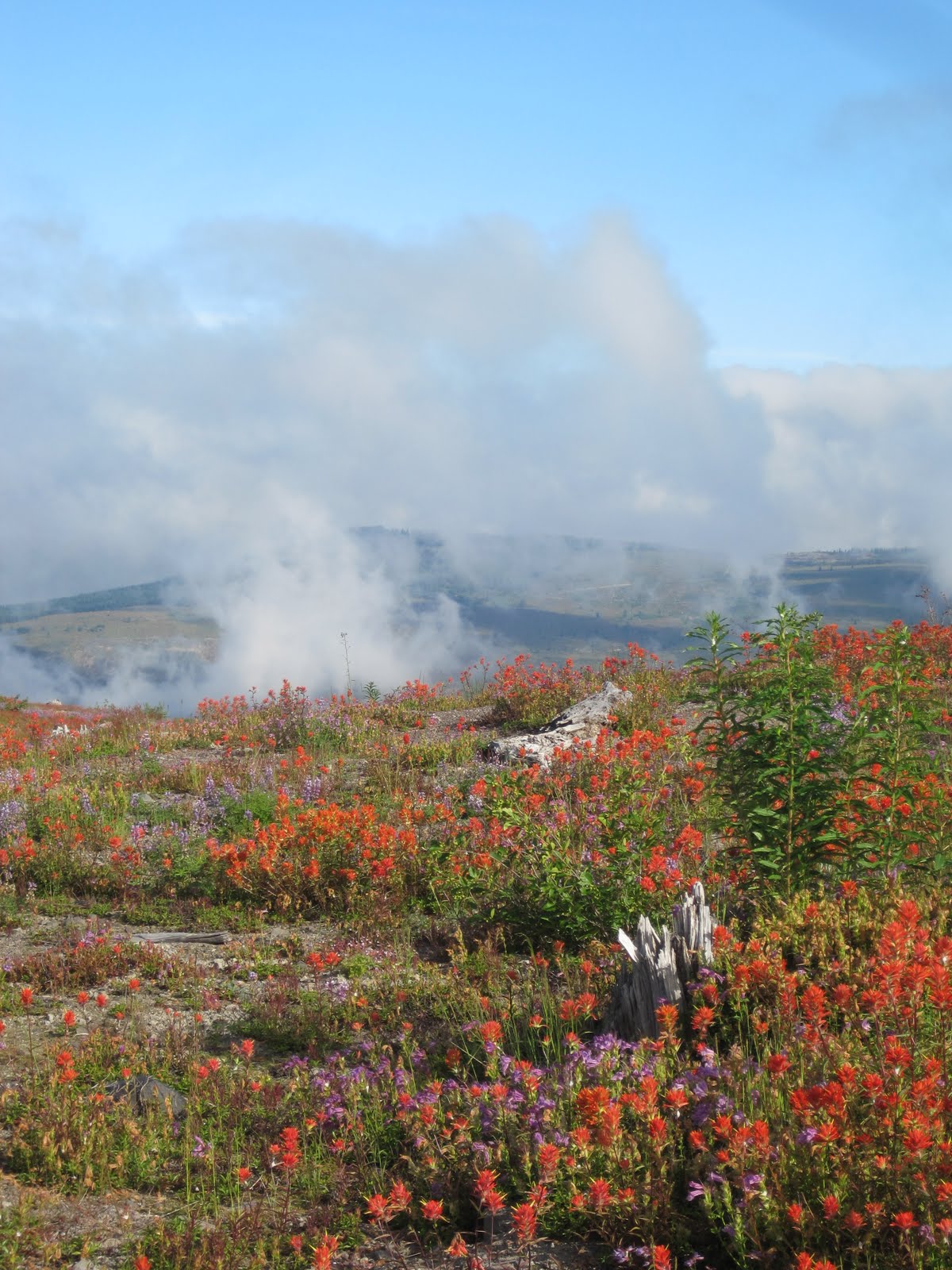
I wandered about enjoying the solitude and the lovely examples of early vegetation. These flowers have repopulated naturally. The whole monument is one large science lab of discovery. Blasted stumps show the force and power.
Dominant flowers are Indian Paintbrush ( red) Lupins ( blue) and Cardwells Penstemon
This bare slope certainly gives you a lot of information. The remaining logs show you the direction of the blast. The ruts show you where downed trees, since rotted away have left impressions further channeling water to groove the soil.
On a north facing slope these odd mushrooms are likely thriving on log buried, rotting wood.
To the north and east the Coldwater Ridge shows the effect of loss of trees, the addition of the ashy layer and the odd pattern of runoff scars.
The eruption created, and destroyed, several lakes. Coldwater Lake has become a popular fishing destination. The boardwalk out onto the lake shows water as clear as glass. The fishermen in their little boats were not in a chatty mood. I wanted to ask about the clarity further out.
I was happy to be able to capture one oddity, which showed up well on my picture. In 1983 many of the hills surrounding the monument were replanted with Nobel Fir. This has led to an odd and interesting effect. The trees are monoculture, all from nursery stock and all highly uniform. The visual effect is some odd double vision blurring. Look closely, each one uniform and so like the next. I suspect before long, storms and time will take their toll and other trees will creep in and get hold. Will this land eventually be harvested , or was it determined that this tree species is the one most likely to do well in this unique soil system. I really don't know.
The Wikipedia entry for Mt St Helen's is well done. There are lots of good links and photos. Please pay a visit.
http://en.wikipedia.org/wiki/Mount_St._Helens
I hit the road home early. I-5 northbound especially between Olympia and Seattle is MISERABLE on Sundays. No matter what happy times you had in the day, the traffic is sure to harsh that happy. I decided that I would take the back road, Hwy 507 from Centrallia to Puyallup then up the Valley Freeway to Hwy 18 . Cut over to North Bend and get home via the backdoor.
At noon I got to the coffee stand in Centrallia, where the young barista (and former commuter to Tacoma for college, poor kid) approved of my plan. I heard on the radio that traffic was already backed up at the Nisqually River.
By the time I got to the backside of Joint Base Lewis and McCord the I-5 Freeway backup was about 8 miles...then 10 miles. I shook my head in pity over those folks and smiled at my good plan. I knew the core of Seattle was no better with the I-90 bridge closed and people out enjoying the rare perfect 75 and sunny day.
I got to North Bend in three hours!!! That is a huge record for this drive and I will use this back road to happily meander home when I am in the south and west
Subscribe to:
Posts (Atom)