About Me

My photo
Just a meandering soul sharing my backyard. Visit my Flickr page too! www.flickr.com/photos/meanderingwa/

Saturday, July 2, 2011

Like Here, Only Different ~ Tracks in Traps

Of all the varied experiences, I think learning about and working with track traps was the most interesting and exciting.

We started out on one of our first days for the trap track making exercise.  A track trap is 1 meter by 1 meter.  Typically on trails they are spaced every 250 to 500 meters apart.  The debris is cleared and the soil is chopped up with a machete.  First thing we learned at station was how to properly sharpen and carry the machete.  We all had a go at the proper 45 degree angle whacking needed for most efficient cutting.


Cutting up the soil is a different matter.   A cross between chopping meat and making bread.  Once a trap is dug , the maintenance work is easier.  Breaking virgin soil took a lot of angled whacks.  The rough clods are gathered up and further whacked and chopped into a finer grit, then gathered further and whacked some more.


Then the whole pile is distributed and smoothed


Then you get to stand back and admire your handiwork.  Perhaps dreaming of what might leave its mark.


Traps were checked as part of daily walks.  It is more of a challenge than you might think. 

Leaves fall constantly and they leave imprints in the soil.  Moisture falls from the trees every morning and the rain drops leave splatters of imprints.  Sometimes when a leaf is positioned above,just so, its drip tip runoff produces imprints which resemble the footprints of the smaller animals.

But key to foot print identification is that there are more than one print.  The one meter square captures stride length and multiple footfalls of the animals that live here.  Sometimes it is possible to see the tail mark left from an armadillo and we even found a snake mark.

At the mammal colpa, the sticky mucky ground is smoothed over as best as possible to help identify the animals and birds visiting the clay. 


Arriving at a trap the debris is cleared very carefully, noting what marks the leaves leave.  Marks are examined very carefully.


Lighting is everything and a flashlight was a vital tool.  By lighting from different angles you can see subtle impressions and shapes that  might otherwise be missed in flat, full light.  Photography can be a challenge and shading with your body and side lighting sometimes helped make the recording picture.  Sara was brilliant at analysing signs and shared her vast knowledge with us.  Under her guidance I felt confident evaluating the traps myself.


My first assignment was into an area, a special bit of hell called "The Matrix"

The matrix was a 300 meter by 300 meter grid of 49 traps spaced 50 meters apart and numbered like a conventional X/Y grid.  0/0 the start - 0/150 three tracks up that line... and so on all the way over to 300/300.  At the center of the matrix is the Mammal Colpa.  We had come over the day before and whacked the foot ways to beat back some of the brush.  We also reset the traps making the soil smooth.  The area had not been visited for some time and it was serious rough going.  Often the only way you could see was small red or yellow ribbons hanging in trees.  You also used a compass bearing, the grid being set up on due north/south lines with connectors alone the "0" and "300" line east and west.  once on a line there was no east west connection, you had to go all the way to the end.  Lastly you could see machete marks from previous cutting.  I think during these times of navigation and observing the vegetation wrapping completely around us, seeing the machete marks is when I had that first "I am really here and REALLY in it" moment.


The challenge of walking back and forth in the matrix, navigating without an expert present AND actually making identification of the footprints we found was a solid effort of which I am pretty pleased.

There was a Control Matrix that was a bit apart from the study matrix.  This grid had no colpa, but did have the same winding stream cutting through its center.  Crossing that stream on each line got to be a bit trying.  Often the bank was steep and broken.  Seldom were their logs and thankfully in the dry season the water only came half way up the boots.  The downside was that the control matrix was rougher , less trod.  Navigation was challenging and a couple large downed trees made getting across the top of the grid impossible.

During one trap evaluation duty I was navigator.  It was the end of a very long day and I was darn pooped.  It was time to navigate out of the matrix and I took the bearing and we headed out.  The trap 50 meters from our start had prints in it.  I looked at them and at the trap id strip and asked, "didn't we check this one?"  Yes we had checked it.  Now there were fresh Jaguar prints in it.

She was just there.  She probably had us under surveillance the whole time.


Wheeee it was a little thrill.  The lucky part was, I guess, that i had navigated us the wrong way and made a 180 degree error.  If I had done it right the first time we would not have had that little thrill.

Easier duty was the Mammal Track detail.  Traps every 250 to 500 meters along the transect trails meant brisker walking.  You could take time to watch the environment and even stop to enjoy birds or animals you might see.  The traps yield just as much fun stuff as the matrix.  Indeed, one transect was a Jaguar Highway.  Paw makes in both directions.  One one walk we encountered a trap with easily 20 prints in it.  We called it the Jaguar Dance floor.  It looked like the cat had stopped and perhaps turned this way and that.  I am sorry my pictures did not turn out.

But here are a few that did.

3 nice Jaguar prints


That is my hand


The prints in a trap are not always so clear cut.  These prints gave Alan a pause.  It was a matter of deciding what they were not and then noticing a detail.


Moderate foot sized with long deep finger like toes.  Not a cat, not a canid.  Not a primate, certainly not hoof stock.

The Alan noted that the footfall was together.  Two prints side by side, two sets of them.  A member of the Weasel family does this.  And this sized weasel could mean only one thing.  Giant River Otter.  An odd location but not so very far from a stream that an animal might not have come up from the river.  We walked along and it was not very long before we found a huge pile of ants.  You bet, those ants love scat and when shooed away we found poop.


That Ladies and Gents, is Otter Poop ( not to be confused with that Summer treat "Otter Pop" ) .  The white flecks, indeed most of it, fish scales!

The last full day of our time at camp, I trekked out with Sara and three other team members.  We evaluated the track traps along the Brazil Nut Farm trail and once we got to the end we were to continue on further into rough territory to recover cameras from  some distant placements made the days previous.  Nick and I navigated with GPS and compass.  He had been to this location on the original placement.

Even though he had been to this location, he did not readily recognize one of the rough areas.  We floundered around with the GPS, venturing our on likely paths and returning back.  I think we tried all the false leads and rejected trail efforts of those before us.  This area is harvested for Brazil Nuts and there is a farm on the next property over.  Finally we got on the right track and recovered the camera.  In front of the camera there was a track trap and it showed a bold Jaguar print.  The camera would later show us a blurry image of a male Jaguar.

Sitting there in the jungle far from everyone else we had our snacks.  Rosie, our camp cook, had a little concession of packaged snacks for sale.  I am glad I thought to pack some for this trip.  We were out 8 hours.  The little sugar frosted flakes were just the thing.  Sitting there, a Blue Morpho Butterfly flew into the clearing.  We had talked about hand landing Morphos the day before.  Could I?  Would it?

I tapped some of the sugar crumbs into my hand and put it out.  The butterfly, a four inch wide bit of blue magic circled me three times, each pass coming closer.

And it did land on my hand and politely dabbed at my sweaty palm, totally ignoring the sugar.


This day was the epitome of the whole experience.  Hard work, a bit of adventure, contributing to research and encountering the rare grace of the creatures of this amazing place.

I so long to return.


Thursday, June 30, 2011

Like Here, Only Different ~ Tra La the Flowers of Winter

Technically it is Winter now in Las Piedras.  There were few flowering shrubs or vines about and I imagine those that do bloom, do so high in the treetops.  The walking paths were often littered with individual blossoms blown down.

So here is a bit of random pretty.

The end of a Banana Tree blossom.


Hibiscus


Dry and sleepy looking, don't you think?


These were particularly common.  I thought they were Balsa but I understand Balsa blooms white.


This was blooming along a main trail.  I saw it as we returned to camp one day and never saw it again.  It looks like the stamens are loaded with sugar droplets.  I am sure a butterfly moth or hummingbird found this most wonderful.


This has some characteristic of a Rosa sp.


Not sure if this is a seed pod or a flower.


These blossoms were everywhere on the jungle floor.


Like Here, Only Different ~ Orchids for Ron

Anyone who has spent time here on my blog knows my growing affection for orchids, particularly our native terrestrial orchids.

My interest was sparked via contact with Ron Hanko who has a couple blogs, including one about his home grown orchids. 

I was keenly aware of the potential for finding orchids while in Peru but I was not too sure how much I could discover.  A majority of orchids grow high in or on trees.  Thinking along these lines, most downed logs I encountered got a once-over as best I could.

As we walked the trails I found orchid plants that had blown out of trees, though none of them were in bloom.  I placed some of these bundles onto logs of downed trees in hope that they might set their roots.

One downed and disintegrating log allowed the collection of a few unfortunate small orchids for a possible culture and rehoming.

At home base, many of the trees held orchids that were found as knockdown rescues.  One tree supported some small, natural orchids.  Here, for my friend Ron, some of the little gems.

On a home tree, several of these were in bloom.

Ron, is this a Masdevallia???!?


Ron says this is Trigoniodium acuminatum


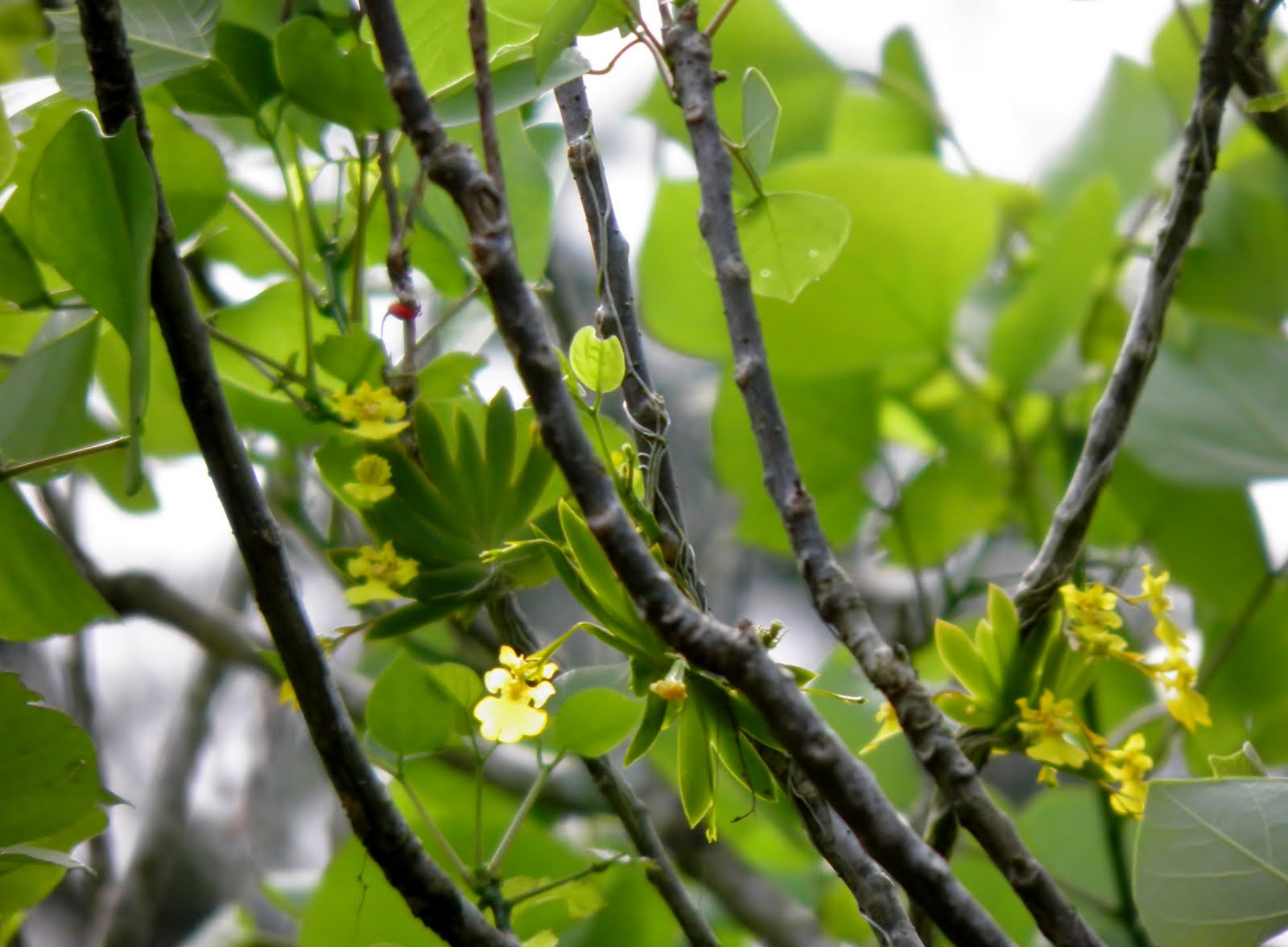
In another small tree, these appeared to be growing naturally.  Of course, they were out of reach and yellow, that cursed color for photography.  They remind me of Oncidium.  Their leaves were small and arrayed like a palm fan.

Ron says they are Psygmorchis pusilla.  They were wonderful!


Lastly, on a fallen tree I found this in bloom.  Deep in the understory, this color was tricky with my shaky hands and sometimes steamy camera lens.  I tried to capture these pale blooms several times.  Are these an Epidendrum?  Ron says yes they are but cannot tell the species.


The flowers were amazingly tiny at the end of long spikes.

I was sorry to not find more orchids, but had great pleasure finding those I did.

For those who appreciate great photography and the wonderful world of orchids, Rons Blogs are a feast for the eyes. His Orchids in Bloom represent his home cultured orchids, many of them from South America.

http://orchidsinbloom-ron.blogspot.com/

http://nativeorchidsofthepacificnorthwest.blogspot.com/

Rons Ramblings around the Pacific Northwest

http://ronaldhanko-orchidhunter.blogspot.com/

Wednesday, June 29, 2011

Like Here, Only Different ~ Smile You're on Candid Camera

You cannot be in all places at all times. 

No matter how slow or how quiet you are, the animals and hear, smell, feel and sense your presence LONG before you know they are around.  (Well except the Peccarys, everyone nose where, when and from what direction they come and go.  Peee-yuwee)


It is not hard to imagine what a small group of sweaty humans with suspect clothing and a layer of DEET and Pyrethrum smells like to a sensitive animal like an Agouty or a keen hunter like a  Jaguar.  They often depart long before we see them.

So the motion /heat sensitive cameras are a great tool to have.  They can be set up in key locations and effectively take the place of 24/7 watch duty.  They capture images which can help identify unique features on the cats.  The ocelots and Jaguar can potentially be identified by their coat markings.


The project had four cameras set up in key locations.  A few were set up in very remote areas others in the key study area of the Mammal Colpa and near a large water source.

They are pretty nifty and can take a series of images in a time frame you can set. A removable memory card allowed a team to swap out the data card without bringing the camera back to camp.  Built in flash permitted collection of night images.  Most of the animals species tolerate the flash and no one mentioned any report of an animal harming a camera.


Mounting the camera in high traffic areas like on a trail resulted in many images of the footwear all the team members wore.  In fact, when the images were reviewed on the computer, it was possible to id all of the team members by their footwear.


I was able to obtain some images from our two weeks from the Biosphere Facebook page. 

A Puma ( cougar, mountain lion) at the Mammal Colpa.  It is on the left, just to the left of the tree trunk, behind the main clay area, walking up slope.  At 3 in the afternoon as you see by the tag.


An Ocelot.  The rosette pattern of the fur may make this an identifiable individual.


A Jaguar.  A grand creature.  This is potentially the Jaguar they call Matthias, in honor of the founder of Biosphere.


Sometimes when the animal is very close to the camera you see nothing but the blur, but often the color and general impression is enough to make a species identification. Or you get half a portrait.

Agouty


That is a Guan at the Mammal Colpa on the left.  I am not sure if a positive id was made on the bird on the right.


Looks like a gull to me but that would not be a likely jungle visitor.


It is a shame that there were  only four cameras.  Watching the images come up on the computer was like Christmas Morning!!!

Tuesday, June 28, 2011

Like Here, Only Different ~ Slow Walking

A larger part of our day to day work activity involved walking.  Very. Slow. Walking.  I think, aside from the need for a lot of insecticide spray/repellent, I found walking slowly VERY challenging.

Transect walks and behavior observations were done daily on any of the four  transect trails; Mammal Colpa , A, C and Brazil Nut.  Each was a different length but most range from 3 to 4 Km one way.  I loved having a good, solid walk every day in such an interesting environment.  The Brazil Nut trail was the longest at about 10-12 Km round trip.

During Transect walks, a team of two or three observers, led by one of the scientists, walked the length of the trail.  The goal was to find key animal and bird species in the environment and when they were encountered collect data on their numbers, behavior and location.  Questions about the impact of humans in the populations and behaviors of the animals require more data as eco-tourism increases.  The needs of key or threatened species like the cats must be established.  Range, territory and prey species need to be understood.  How the mineral colpas serve the needs of the animals may lead to considering their locations and abundance in protecting habitat.

Typically the scientist would lead, focusing on the immediate area on, above and next to the path.  The second would watch the area slightly deeper into the habitat and above.  The person in the rear observed even deeper into the habitat and to the rear to make sure there was no animal following or fleeing behind.

We walked at 1 Km /hour which is a very slow pace for me.  It was also important to maintain as quiet a step as possible.  Sometimes this was a challenge given the amount of leaves on the ground and the presence of twigs and stems.  Silence was also important as often the only hint of an animals presence or fleeing was the rustle of the vegetation.  This ditch crossing and trail are somewhat typical of many of the paths.  Rustly leaves.  Trying hard to be quiet is a challenge.  Like trying to sneak into the cookie jar, the harder you try, the more you fumble.


When an animal was encountered they were watched and their behavior or reactions were categorized.  We also recorded their distance from the trail and height above the trail using range finders.  Where there were multiple animal, there was an attempt to count the number of juveniles and babies.  Usually the animals flee and are not seen by all the team members.  The best chance of seeing animals was during the primate encounters.  Typically the monkey troops were spread over a wider area and they passed overhead in noisy , tree crashing flights. 

Saddleback Tamarins were particularly fun to encounter.  These small monkeys have sort of a feisty attitude, in my opinion.  At times one would approach as if it was far to fierce to be reckoned with and we better leave, by golly!  Mostly a lead animal would watch steadily as the rest of the troop would move away.  Their departure was typically a somewhat purposeful but not frantic navigation.  It seems they were the ones most likely to come near, or be in the lower middle story.  I only got one fair photo of monkeys during the trip.  Usually they were simply too high and better observed in binoculars.


Small mammals of the jungle are challenging as they have the dense understory to shelter them from our eyes.  Paca


and Agouti were most common


with Brocket Deer also possible.


One species we always knew when they were about.  Even if they were not there, we knew they had been.  White-lipped Peccary live in herds of 50+ animals.  They are noisy with squeals, rumbles, clicks and rooting sounds much like common swine.  Their most notable characteristic is their smell.  Holy Cats you know when they have been in your environment!  The smell seems too linger in the nostrils like all musky scents.  They are also potentially dangerous if they charge as they are not afraid of charging right past or through your group.  When they run they really cover ground.  I did get to have one observation of a group of about 75 animals ranging for tiny babies to large adults.  I felt I could still smell them a few hours later.  These animals are the Jaguars main prey species.


White-wing Trumpeters earn the name of Heart Attack birds as they would sit right at trails edge until you came close they they would blast away in flight.  I had more than one "heart attack" during my walks.  Spix Guan I nicknamed the Jackass Birds as their braying alarm call reminded me of a Mule.  I think, aside from the tamarin troops these were the most common target species encountered.  I usually got a good look as they would fly up and perch on a branch before moving off.

It was a great treat to get a couple encounters with Tamandua.  These pretty anteaters spend most of their time int he trees seeking ants and termites.  Termite nests are easily spotted in the trees but the Tamaduas, with their slow moving way, were quiet and less obvious.


Creatures that eat ants and termites have a good living in this environment.  Ants of all types are everywhere and termite nests seem just as plentiful.


Our walks usually started around 545am and we walked (slowly) out about 3.5 to 4 Km before turning around and coming back to camp.  At the study pace this was usually 6 hours.  During the second week we covered some of the transect trails in reverse, walking all the way to the far end then starting back (slowly) at 6am.  This meant getting up at 330 to hit the trail by 4am.

This day we had a shortfall of provisions due to a logistics issues and packed some cookies and crackers to nibble on before starting our walk at 6am.  I have to say there was something sort of special sitting on a log deep in the jungle as it woke up, eating Oreos.

The great bonus of doing this transect is that we were 1 Km from home base when we finished.  A short quick walk and there we were.  It was 11 am and why not, we peeked into the kitchen.  We struck it rich with our special treat.


It was so good and so welcome I took a picture of it.

Chef Rosie's Buñuelos and Coffee.  The Coffee was that which was picked on the neighbors farm property and roasted right there.  The buñuelos are made with pumpkin puree, flour, eggs and milk then deep fried.  Strawberry jam and Dulce de Leche are the topping.


Sweet tasty bites of heaven. 

As before, the animal photos, except the tamarin, brought to you by Google Images.  (sigh)