Another year passes. Quotes from John Muir.
One learns that the world, though made, is yet being made
Of all the fire mountains which like beacons, once blazed along the Pacific
Coast, Mount Rainier is the noblest.
The power of imagination makes us infinite
The grand show is eternal. It is always
sunrise somewhere
Lowly, gentle fellow mortals, enjoying God's sunshine
How many hearts with warm red blood in them are beating under cover of the woods, and how many teeth and eyes are shining!
When one tugs at a single thing in nature, he finds it attached to the rest of
the world
Writing is like the life of a glacier; one eternal grind
Ramblings around Washington State. Natural wonders of my world. I am forever trying to learn. Strong caution, pictures of plants may include bugs,spiders and other "creepy" things. Natural history plants flowers bugs birds biologies. Geology weather conservation and gentle hikes.
About Me
- Upupaepops
- Just a meandering soul sharing my backyard. Visit my Flickr page too! www.flickr.com/photos/meanderingwa/
Showing posts with label Mt Rainier. Show all posts
Sunday, April 22, 2012
Thursday, February 23, 2012
V ~ Volcano
Without a doubt, the volcanoes of Washington State are a surprising lot. Most people can look at Mts Baker , Rainier, Adams and St Helens and know just by appearance that they are volcanoes. More surprising is Glacier Peak, a rough craggy mountain in the central Cascades. This mountain does not have the classic cone shape that defines our other regional volcano's.
All have potential to erupt in the future. Their eruptions are not set in any fixed rate of frequency, like some volcanoes of the world. All produce lahars, flows of ice mud and gasses. These mud flows are responsible for many of the flat fertile areas of western Washington. The Osceola Mud flow of about 5000 years ago is said to have originated at the top of Mt Rainier, lowering it by 2000 feet and producing a mud reaching to Puget Sound. It is said that it created up to 450 sq Km of new shoreline and in some places still measures 200 feet deep
There has been a lot learned from Mt St Helens both during its eruption and the subsequent growth phase. Science of eruption improvement has advanced and data collected on St Helens has aided in predicting dangerous events in other areas of the world, no doubt saving many lives.
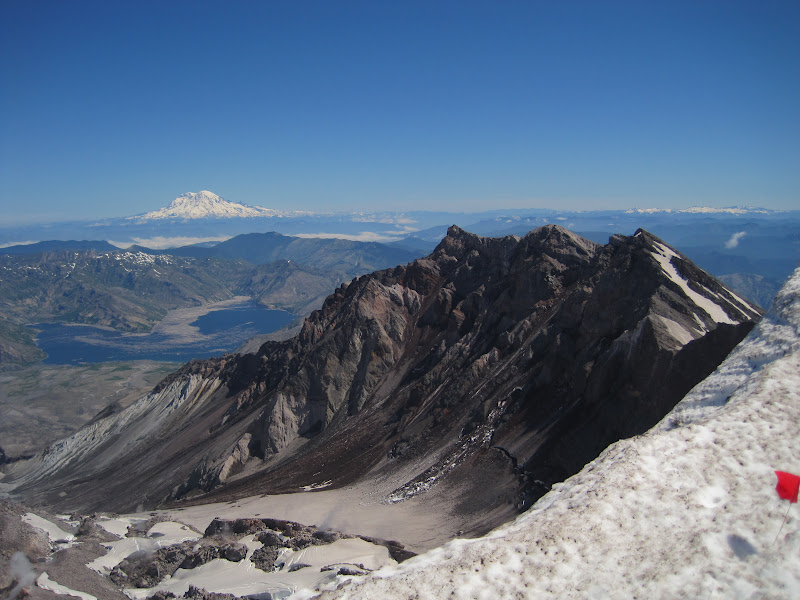
The above picture taken from Mt St Helens in July 2010. Mt Rainier is seen in the distance, about 50 miles north.
Labels:
A to Z,
Mt Rainier,
Mt St Helens,
Osceola mud flow,
volcano,
Washington nature
Sunday, February 19, 2012
R ~ Rainier
Dahkobeed. Takkobad. Tacobud. Tahoma. Dahkoobed
All of these names applied to the most impressive of landmarks in Washington state. There are many myths and legends attached to this mountain. Dahkoobed is a jealous wife, shooting fire at the junior wives of her husband. Mysterious lakes hidden inside the mountain are home to otherworld spirits.
These myth come from reality. In the summit crater of the 14411 ft volcano there is a lake along with 2 miles of ice caves. Summit climbers can sometimes smell sulpher in the air.
Currently the volcano is dormant but all around are well aware of the danger the massive store of ice and snow hold if the volcano should return to life. There is an estimated 35 sq miles of perminant ice and snow on the mountain. Historic mud flows have reached all the way to Puget Sound.
Mt Rainer is a training ground for many world climbers who use its technical slopes to train for climbs in the Himmalayas. For the average walker and hiker, its lower slopes are easily accessed. During the Summer, superb wildflower meadows attract large flocks of visitors.
For residents of Puget Sound country, a clear day means Rainier dominates the view.
Is it a nice day? Yes, The Mountain is out.
The Mountain is out. Everyone here knows what that means.
Labels:
A to Z,
Indian myth,
Mt Rainier,
Washington nature
Tuesday, February 7, 2012
G ~ Glacier
Glacier
Much of Washington’s topography is due to the deformations made by glaciers of the Ice Age. These happened both directly and indirectly when a glacial dam burst in Montana several times over a millennium producing the Bretz Floods 13 - 15000 years ago.
Mt Rainier is home to 26 major glaciers. Nisqually, pictured here, is much diminished from 40 years ago when it was recorded advancing 29 inches in one day. I have been above this glacial valley and heard the booms and cracks of its movement. When the sound arises from a foggy misted landscape, you can believe in dragons.
Labels:
A to Z,
Bretz Floods,
erosion,
glacier,
ice,
mountain,
Mt Rainier,
nisqually glacier,
snow,
valley,
Washington nature
Sunday, January 1, 2012
Sad News for Our Outdoor Community
Not the entry I wanted to post for today,
I wanted to post about my fun day today, but will leave that for tomorrow. Arrived home to news that simply saddens my heart and spirit.
Mt Rainier National Park Ranger Margaret Anderson, a mother of two and married to another park ranger, was shot and killed this morning after setting up a roadblock to stop a fleeing suspect.
My thoughts to her family, friends and to all who love and serve our great outdoors.
Sunday, July 31, 2011
Orchid Field Trip
Had a quick trip to a location in the Cascades. This is the only spot for that county known to contain Clustered Ladyslipper.
It was a glorious day. I left early so I could stop by Sun Top during my drive. I knew I could bring you this glorious shot. It is one of my favorite vantage points.
The snow will stay on this mountain year round, but the lower peaks really are late in melting off.
But that is not stopping the upper elevation flowers from doing their thing. Here the morning sun really made things pop. This is Beargrass and a little Syrphiae fly. Click on the photo to enjoy this pretty insect.
A tangle of Red Columbine in the rocks.
A Western Anemone is more commonly called a Tow-headed Baby, due to its fuzzy , hairy seedhead. I hope to get up here when they set seeds.
It was fun to spot the stamens in these Lupin blossoms.
Continuing on after many more miles where Pearly Mae performed brilliantly, I met with a small group and we hiked a ways to find these lovely and rare orchids. Last year we visited some in another part of the state and they were very difficult to find in the underbrush.
Today they were right underfoot.
Clustered Ladyslipper aka Brownie Ladyslipper.
They come in a pale and a red form. Some we saw last year were much redder, but these were bountiful and so easily viewed. What a fun treat.
There were also some Western Coralroot and this form was so pretty with both pale and purple coloration
It was so nice to get up into the alpine area. Many of the familiar alpine flower hikes are still snowed under and I suspect we will not have much of a year again.
It was a glorious day. I left early so I could stop by Sun Top during my drive. I knew I could bring you this glorious shot. It is one of my favorite vantage points.
The snow will stay on this mountain year round, but the lower peaks really are late in melting off.
But that is not stopping the upper elevation flowers from doing their thing. Here the morning sun really made things pop. This is Beargrass and a little Syrphiae fly. Click on the photo to enjoy this pretty insect.
A tangle of Red Columbine in the rocks.
A Western Anemone is more commonly called a Tow-headed Baby, due to its fuzzy , hairy seedhead. I hope to get up here when they set seeds.
It was fun to spot the stamens in these Lupin blossoms.
Continuing on after many more miles where Pearly Mae performed brilliantly, I met with a small group and we hiked a ways to find these lovely and rare orchids. Last year we visited some in another part of the state and they were very difficult to find in the underbrush.
Today they were right underfoot.
Clustered Ladyslipper aka Brownie Ladyslipper.
They come in a pale and a red form. Some we saw last year were much redder, but these were bountiful and so easily viewed. What a fun treat.
There were also some Western Coralroot and this form was so pretty with both pale and purple coloration
It was so nice to get up into the alpine area. Many of the familiar alpine flower hikes are still snowed under and I suspect we will not have much of a year again.
Wednesday, April 20, 2011
Happy Earth Day
Wise words from John Muir (21 April 1838 – 24 December 1914)
Naturalist, writer, adventurer, advocate and founder of the Sierra Club.
Happy Birthday
"When one tugs at a single thing in nature, he finds it attached to the rest of the world"

"Anyhow we never know where we must go, nor what guides we are to get---people,storms, guardian angels, or sheep...."
Naturalist, writer, adventurer, advocate and founder of the Sierra Club.
Happy Birthday
"When one tugs at a single thing in nature, he finds it attached to the rest of the world"
Writing is like the life of a glacier; one eternal grind."
"Between every two pines is a doorway to a new world."
"As long as I live, I'll hear waterfalls and birds and winds sing. I'll interpret the rocks, learn the language of flood, storm, and the avalanche. I'll acquaint myself with the glaciers and wild gardens, and get as near the heart of the world as I can"."
"Going to the mountains is going home."
"Anyhow we never know where we must go, nor what guides we are to get---people,storms, guardian angels, or sheep...."
Labels:
bee,
Cotswold Way,
Forest,
John Muir,
Kendall Katwalk,
Mt Rainier,
Mt St Helen's,
Nature,
nisqually glacier,
path,
quotes,
Salisbury,
Spirit Lake,
trees,
waterfall
Sunday, September 19, 2010
Nisqually Land Trust ~ Mt. Rainier Gateway
Saturday I joined the Nisqually Land Trust in what is the first volunteer event of the new 2010-11 work party season. I wrote about several events I attended over the last year and we are off on a new season of working in the great outdoors, no matter the weather.
The forecasts for this weekend were nothing to be happy about. It seemed doom and gloom but the reality was not that bad. I was fully prepared to get soaked through and went prepared with a full change of clothes. We had, however, the most glorious morning. It did in fact get downright hot while working. Mind you we had pretty much full sun and digging and whacking is hard work.
The property is one I had not been to before, The "Allen Estate" on the east edge of Ashford, right at the Mt Rainier NP gateway. www.nisquallylanddtrust.org/mtrainier/php
I had not been this far up the road in so very long. This property is that of the historic homestead of Oscar Dana Allen. Mr Allen was a contemporary of Gifford Pinchot who was the first chief of the US Forest Service and coined the term "Conservation Ethic". Along with his sons , Mr Allen made the first botanical assay of the park. He and his sons went on to be key in the administration of the park and state forests in the early half of the 1900's
My drive took me through the Ohop valley where last Halloween we had a work party to plant the valley floor. I stopped along the way to take a picture. While you might not be able to tell, I can see the green shrubs and trees we planted, hiding amid the tall grasses that have since sprung back up. There will be another Halloween work party this year and you can bet I will try to attend. You can see the photos from last years event in my 10/31/2009 blog entry.


Recycled Spirits of Iron by Dan Klennert


The rough grass needs to be whacked back and the turf and soil removed, the hard part. Dig and plant, the easy part. Well the easy part was based on where you dug. Clearly there was a large rock topped drive under this spot. From the state highway we drove up what once was an access road. Joe's truck created a perfume of "mint" as he drove over the greenery that carpeted this path through the woods. The only native mint I know of is Self Heal. I have never crushed it to see if it smells as lovely as this. The open area was overgrown with native blackberry, nettle and non native Scots Broom. Hidden was where the access lane continued on. Shovels found it in the form of rough egg sized rocks covered over by soil.

Sun Mountain


Nisqually Glacier
The forecasts for this weekend were nothing to be happy about. It seemed doom and gloom but the reality was not that bad. I was fully prepared to get soaked through and went prepared with a full change of clothes. We had, however, the most glorious morning. It did in fact get downright hot while working. Mind you we had pretty much full sun and digging and whacking is hard work.
The property is one I had not been to before, The "Allen Estate" on the east edge of Ashford, right at the Mt Rainier NP gateway. www.nisquallylanddtrust.org/mtrainier/php
I had not been this far up the road in so very long. This property is that of the historic homestead of Oscar Dana Allen. Mr Allen was a contemporary of Gifford Pinchot who was the first chief of the US Forest Service and coined the term "Conservation Ethic". Along with his sons , Mr Allen made the first botanical assay of the park. He and his sons went on to be key in the administration of the park and state forests in the early half of the 1900's
My drive took me through the Ohop valley where last Halloween we had a work party to plant the valley floor. I stopped along the way to take a picture. While you might not be able to tell, I can see the green shrubs and trees we planted, hiding amid the tall grasses that have since sprung back up. There will be another Halloween work party this year and you can bet I will try to attend. You can see the photos from last years event in my 10/31/2009 blog entry.
I passed wood art and metal art. Recycled Spirits of Iron by Dan Klennert is a fun stop along the way. There is also an excellent coffee stop at the Ashford HQ of International Mountain Guides. After working I stopped at Copper Creek Inn, near the park gate for an excellent bowl of stew.
Recycled Spirits of Iron by Dan Klennert
This work party was a two-part. Start by pulling out Scots Broom ( yippee violence mayhem and destruction) and then plant Douglas Fir trees. The Scots Broom pull is made easy with root jacks and plenty of hands. Our little group made short work and then got on to the trees. They were beautiful! One volunteer had nurtured them through the summer and she reports they had easily doubled in their size. Every pot, tree and hour spent in raising these trees along with the greenhouse space at Pack Forest was donated. A labor of love.
Look at these little darlings. Classic Christmas trees that will grow to be our regions iconic tree. The green tapes will make them easy to spot while they are little.
As usual, Joe Kennedy gave a demo on how to properly plant the trees.
The rough grass needs to be whacked back and the turf and soil removed, the hard part. Dig and plant, the easy part. Well the easy part was based on where you dug. Clearly there was a large rock topped drive under this spot. From the state highway we drove up what once was an access road. Joe's truck created a perfume of "mint" as he drove over the greenery that carpeted this path through the woods. The only native mint I know of is Self Heal. I have never crushed it to see if it smells as lovely as this. The open area was overgrown with native blackberry, nettle and non native Scots Broom. Hidden was where the access lane continued on. Shovels found it in the form of rough egg sized rocks covered over by soil.
We cleared the area of broom and planted 100 trees in three hours. There was time for a chat break where we learned about the property and of the long term effort in this area. The preservation of blocks of habitat provides for all of the animals and flora with particular attention of the habitat needed for Spotted Owl and Marbled Murrelet. The murrelet is a seabird which nests in the forest. They will fly out to the Pacific Ocean and back to this area EVERY DAY during nest season. That is about 125 miles one way. I have only ever seen murrelet on the ocean, never in the woods.
After work and a bit of lunch, I decided since I was all the way up here, I might as well go home the "pretty way". So I entered Mt Rainier NP and circled around via Paradise. I used to drive this road every summer when I lived further south from Seattle. Now it is much easier to access the park from the Sunrise area. I love this road from Longmire to Paradise as it is very wild. Much as it was in the early part of the 1900's it is two lanes almost no shoulder. Giant trees edge right up to the road much like the Hoh Rainforest Road. Every so often you see where one of these close trees have taken whacks from wide load motor homes. I have to imagine there are a lot of motor homes who have lost their passenger side mirrors. Deep scars about mirror high mark these trunks.
I stopped along the way at different points just to enjoy the sights. Mt Rainier creates it own weather and I went from the sunny clear miracle morning to a totally socked in mountain in about 40 minutes.
Sun Mountain
I love seeing evidence of the historic CCC work crew constructions. Tunnels and stone bridges in particular. The view area for Christine Falls allows you to see the lovely stonework.
Box Canyon a 180 foot deep gouge made by the Muddy Fork Cowlitz River has a wonderful tunnel on its west side. Along the trail you can see the glacier carved stone that makes up this canyon and its walls. Here it is simply stone covered by moss and lichens.
I did find some evidence of late summers bloom but for the most part they are gone and now the hillsides are hues of yellow and gold with occasional Mountain and Vine Maple trees adding their color.
Paintbrush and Pearly everlasting.
An Earth Star type, Geastrum sp. puffball
Lovely Redwood Sorrel
The Nisqually Land trust takes its name for the beautiful river that carved this territory and the people who call it their homeland. The Nisqually River starts at the foot of Nisqually Glacier a sadly reduced glacier but never the less powerful to experience. I have been up on the trials above the glacier and you can hear sounds in the mists that tell you there is a power deep in this river of ice.
The young river in its glacial valley
Nisqually Glacier
Monday, July 12, 2010
A Return To Mt St Helen's
I last visited Mt St Helen's three years ago with a group from work. In May, on the anniversary date of the eruption, I posted some pictures from that trip. I returned this weekend along with some friends from work
Conditions were far different from my last visit. Due to our protracted Spring with its late snows, there is a large amount of snow remaining on Monitor Ridge, the trail up to the crater rim and on the rim itself. This caused me a fair amount of concern but communications with others who had recently climbed made me feel I could do this again.
I drove down early on Saturday as I wanted to visit Ape Caves. This lava tube is part of the Volcano Monument and was discovered in 1948. It is not named for Bigfoot, but rather a name for a Scout troop that frequented the area. This tube formed when lava flowed and cooled creating a tube which liquid lava could continue to flow through. After the activity ended, the tube remained hollow. A cave-in led to its discovery many centuries later.


The rocky line is what you follow to the top. You can see that the snow is a main feature. Large posts mark the way. Many people opted for walking the snow on the other side of the ridge all the way up. I decided to stick to the rocks until the last mile.

I cannot imagine who worked on getting these posts up to the area and erected. They are huge. Prayer flags are found on most mountain summits but this pole on the way up had some as well.


Mt Rainier, Spirit Lake and the east rim of the crater.

Mt Adams to the east. See the small red flag to the left of the ski poles? You don't want to cross that point. Where we are standing is the true rim, everything else is subject to change. The man in the cap is our trip leader and if you look to the left of his feet you can see a crack in the shelf.


Conditions were far different from my last visit. Due to our protracted Spring with its late snows, there is a large amount of snow remaining on Monitor Ridge, the trail up to the crater rim and on the rim itself. This caused me a fair amount of concern but communications with others who had recently climbed made me feel I could do this again.
I drove down early on Saturday as I wanted to visit Ape Caves. This lava tube is part of the Volcano Monument and was discovered in 1948. It is not named for Bigfoot, but rather a name for a Scout troop that frequented the area. This tube formed when lava flowed and cooled creating a tube which liquid lava could continue to flow through. After the activity ended, the tube remained hollow. A cave-in led to its discovery many centuries later.
A hole in the ceiling allows light in and moss and ferns take advantage.
The tube is a chilly 48 degrees year round. On a hot day it is welcome, but you have to take long sleeves with you. There is an easy tube and a more difficult one which requires some rock climbing and one wall to be gained with toe and hand holds.
Our group camped at Climbers Bivouac, 2 miles from Monitor Ridge. This area is open to permit climbers only and limit is 100 climbers per day. We made our reservations in late winter. All around the camp Avalanche Lily were in bloom. It was so nice to sit around the fire and watch stars, satellites and shooting starts dance in the sky. We could hear Great Horned Owls hooting. You could see the summer Milky Way.
Monitor Ridge marks the way, the little peak at the left (look between the tree boughs) needs to be gained after a two mile hike up through the woods. The first two miles in about 1hour, the next 2.5 in about three. It is faster coming down.
The rocky line is what you follow to the top. You can see that the snow is a main feature. Large posts mark the way. Many people opted for walking the snow on the other side of the ridge all the way up. I decided to stick to the rocks until the last mile.
I cannot imagine who worked on getting these posts up to the area and erected. They are huge. Prayer flags are found on most mountain summits but this pole on the way up had some as well.
The last 500 yards are tough. When clear, this is ash and pumice pebbles and is like walking in a sand dune. Now you use the snow steps. You follow in the footsteps of those who went in front of you. I found this very challenging both physically and mentally. If I strode in a comfortable hiking pace, my feet would often slip. I had to place my foot and pause, place the other and pause. Mental and physical exhaustion. I found myself staring at the ground and I knew that I would have a stiff neck today. My arms are also a bit achy from the use of the poles.
But oh the view from the top. There are few words for the view on such a clear day.
Mt Rainier, Spirit Lake and the east rim of the crater.
Mt Adams to the east. See the small red flag to the left of the ski poles? You don't want to cross that point. Where we are standing is the true rim, everything else is subject to change. The man in the cap is our trip leader and if you look to the left of his feet you can see a crack in the shelf.
A dangerous snow cornice shows its layers. Notice how it is breaking apart and drooping? It will drop into the crater soon. The rim is marked with flags and in some places there was easily 20 more feet of snow before open sky. This is simply a snow shelf. In some places you could see cracks developing where it was going to break away.
I did some glissade on the trip down. This techniques can be risky but if you follow in the "buttpath" of those before you, it is simply wet and fun.
I am tired from the shoulders up. The tension in my neck and shoulders from staring at the ground and working walking poles remains. Happily my legs, and more importantly my feet, are in fine shape.
Labels:
Ape Caves,
Johnston Ridge,
lava dome,
Mt Rainier,
Mt St Helen's,
Spirit Lake
Subscribe to:
Posts (Atom)